Florida Flood Disclosure Pinecrest Kendall Seller Playbook
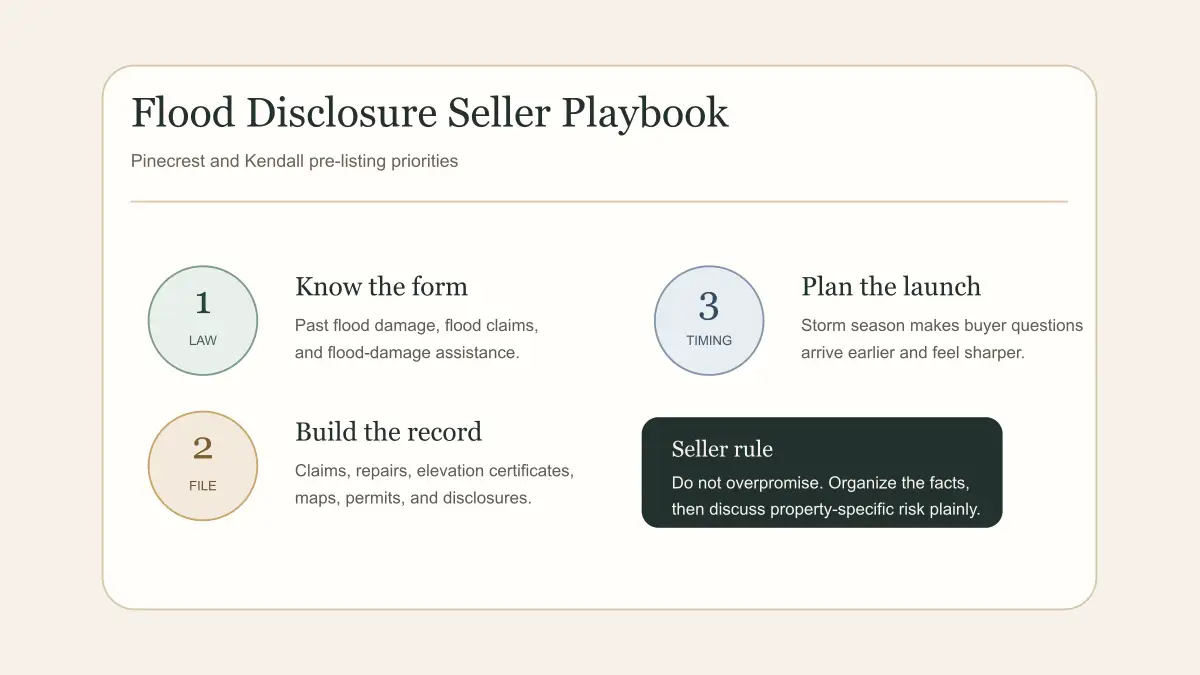
Florida Flood Disclosure Pinecrest Kendall Seller Playbook
If you are selling in Pinecrest or Kendall, the flood conversation should not wait until a buyer's contract package is already moving. This Florida flood disclosure Pinecrest Kendall seller playbook is the practical file I would want organized before the listing goes live: what the Florida form asks, what supporting records make the answer easier, how to discuss prior water history without sounding evasive, and why timing feels different once hurricane season begins.
The key is discipline. A seller does not need to turn the listing into a flood-risk lecture, and the marketing should never overstate what the property is or is not. But in 33156 and 33176, where buyers already think about drainage, tree canopy, insurance, roof condition, and summer weather, a clean disclosure file protects confidence. It gives your agent, attorney, and buyer-facing documents a consistent story before questions become negotiating leverage.
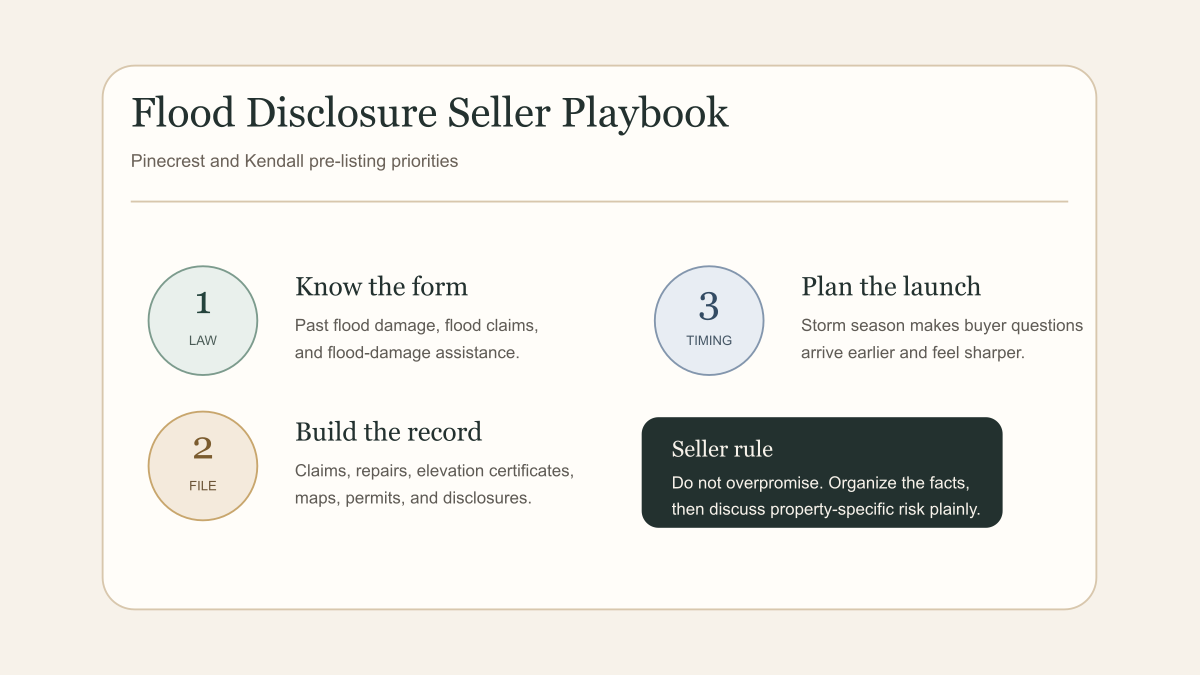 The strongest seller file separates the legal flood-disclosure questions from broader flood-zone, elevation, claims, and water-history context.
What Florida's flood disclosure actually asks
Florida's flood disclosure is specific. Under Florida Statute 689.302, a seller must complete and provide a flood disclosure to the purchaser of residential real property at or before the time the sales contract is executed. That timing matters. The form may arrive at contract stage, but the thinking should happen before launch.
The statutory form asks three practical questions:
| Disclosure topic | What the seller is being asked to address | Why it matters before listing |
|---|---|---|
| Known flood damage | Whether the seller has knowledge of flooding that damaged the property during ownership | Sellers need a calm, accurate answer before buyer diligence begins. |
| Flood-related claims | Whether the seller filed an insurance claim relating to flood damage, including a National Flood Insurance Program claim | Claims history can become an insurance and underwriting question, not just a disclosure checkbox. |
| Flood-damage assistance | Whether the seller received flood-damage assistance, including FEMA assistance | Assistance history should be matched to dates, repairs, and documents. |
The statute also defines flooding for the disclosure. It includes a general or temporary condition of partial or complete inundation caused by overflow of inland or tidal waters, unusual and rapid runoff or surface water from an established source such as a river, stream, or drainage ditch, or sustained standing water from rainfall.
That definition is why a Pinecrest or Kendall seller should not treat the form as only a coastal or waterfront issue. A property can raise buyer questions because of street drainage, older grading, canal-adjacent context, roof runoff, pool-deck drainage, or past storm rainfall. Those details may not all land in the same legal bucket, but they can all affect buyer confidence.
One more point belongs in the open: the statutory form tells buyers that homeowners insurance policies do not include coverage for flood damage and encourages them to discuss separate flood insurance with an insurance agent. That is not a marketing problem for a seller to solve. It is a reason to be precise. You do not want a showing conversation to become "don't worry about it" when the official form itself tells buyers to ask insurance questions.
The records to gather before the listing conversation
A good flood-disclosure file is not a giant binder. It is a short, organized set of records that lets the listing strategy stay calm. Joanna's broader Pinecrest Kendall seller records checklist covers the full pre-listing paperwork habit; for this topic, I would narrow the file to three buckets.
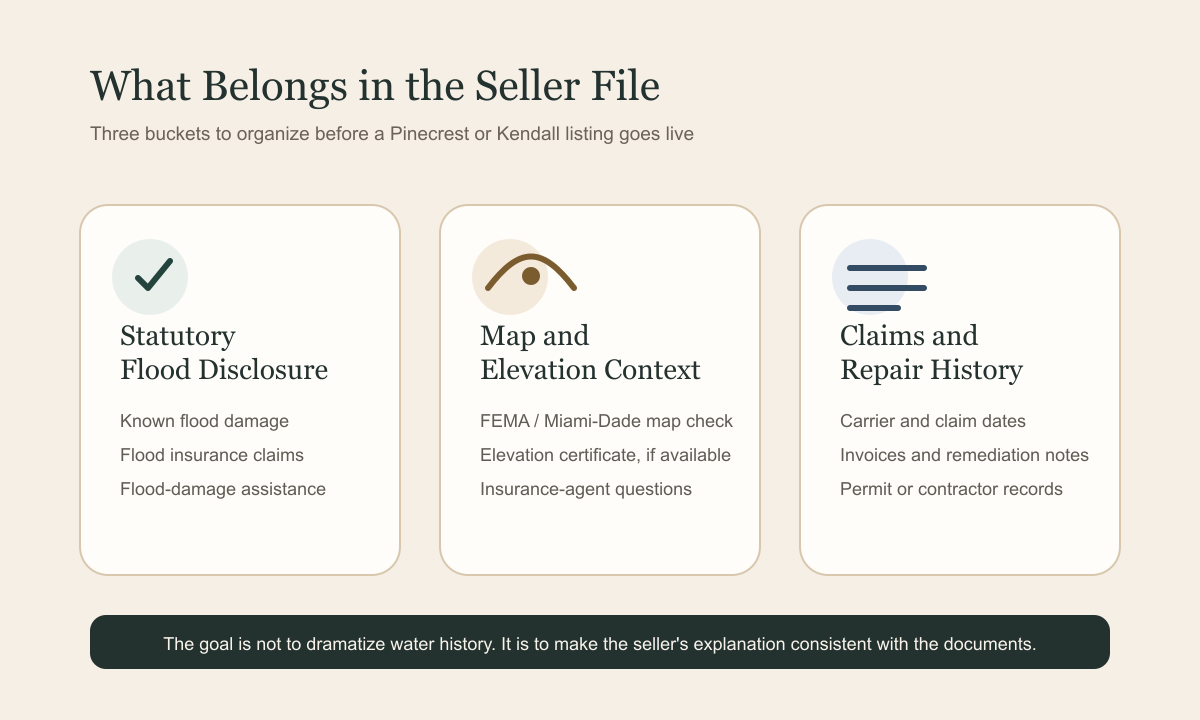 A seller's file should connect the disclosure answer to documents that explain what happened, what was repaired, and what can be independently checked.
First, gather the statutory flood-disclosure records. If there was a known flood event during your ownership, write down the approximate date, cause as you understand it, area affected, who inspected or repaired it, and what documents still exist. If there was a flood-related insurance claim, collect the carrier name, claim date, adjuster paperwork if available, settlement or denial notes if you have them, and repair invoices. If there was FEMA or other flood-damage assistance, organize the approval or assistance record and the repair timeline.
Second, gather the map and elevation context. Miami-Dade's Flood Zone Maps page says FEMA's detailed digital flood hazard maps reflect current flood risks for the county and are used when determining flood-insurance policy rates. The county directs residents to use its interactive tool by address and says official flood-zone designation can be confirmed through the county flood-zone hotline or an insurance agent. FEMA's Flood Map Service Center is also the official public source for flood hazard information produced for the National Flood Insurance Program.
Third, gather the broader water-history file. Florida Realtors' common seller property disclosure form goes beyond the statutory flood form. It asks about past or present water intrusion, drainage or flooding problems, special flood hazard area status, lender-required flood insurance, elevation certificates, and certain flood-guideline issues. That does not replace Florida law, and it is not legal advice. It simply reflects how real-world transaction questions often widen from "Was there statutory flooding?" to "Has water ever affected this property in a way a buyer should understand?"
For claims history, homeowners sometimes forget that insurers may see records differently from memory. The Consumer Financial Protection Bureau's C.L.U.E. company listing says LexisNexis C.L.U.E. collects and reports up to seven years of home insurance and personal property claims, and that consumers can request one free report every 12 months. Not every seller needs to order a report. But if you know there was a water, wind, roof, or flood-related claim, getting your timeline straight before listing can prevent avoidable confusion later.
How Pinecrest and Kendall sellers should verify flood-zone context
Flood-zone context is address-specific. That sounds obvious, but it is where many seller conversations get sloppy. "This part of Pinecrest is fine" or "Kendall is inland" is not a disclosure strategy. Buyers, lenders, and insurance agents will look at the actual property.
Start with the official map sources. Miami-Dade's flood-zone page says the county's maps are FEMA Flood Insurance Rate Maps, or FIRMs, and that residents can enter an address to view the map for their area. FEMA says its Flood Map Service Center can be used to find the official flood map and that flood maps are continually updated, meaning a printed or old saved copy may become superseded.
That does not mean you should promise a buyer that a map tells the whole story. A FEMA flood zone is not a guarantee that a home will or will not experience water. It is one official risk lens. A property outside a high-risk zone can still have localized drainage issues, and a property inside a mapped flood zone can still be well documented, insured, elevated, or improved. The seller's job is not to soften the map. The seller's job is to avoid making claims that the documents do not support.
Elevation certificates deserve the same careful treatment. Miami-Dade's Elevation Certificates page says that once you determine a house lies in a flood zone, a Flood Elevation Certificate can tell how high the house was built in relation to that flood zone. The county also says elevation certificates are required for all new construction and substantial improvements, and that it has collected FEMA Elevation Certificates from builders and developers since 1995 as part of the building-permit process.
If you have an elevation certificate, include it in the file. If you do not, do not invent comfort around it. Note that it is not in your current records and ask the appropriate professional whether one exists or whether obtaining one is useful for the sale. That is especially relevant for buyers who may be thinking about insurance cost, renovation plans, or substantial-improvement rules after closing.
How to talk about prior water history without overpromising
The most reliable seller language is factual, boring, and consistent. That is a compliment. Buyers do not need drama. They need the story to match the paperwork.
For a prior event, the cleanest explanation usually follows this order:
- What happened, in plain terms.
- When it happened, as accurately as you can document.
- What area of the property was affected.
- Who evaluated, remediated, repaired, or insured it.
- What documents remain.
- What you are not able to verify from memory or records.
The mistake is filling gaps with confidence. "It was nothing," "the house never floods," or "that will not happen again" may sound reassuring in the moment, but those phrases can create more risk than they remove. South Florida buyers know that water stories have details. They are usually less alarmed by a repaired, documented event than by a seller who sounds certain but cannot produce a timeline.
There is also a difference between statutory flood disclosure and broader water intrusion. A roof leak, plumbing loss, AC condensation issue, window leak, pool overflow, or drainage problem may not be the same thing as the flooding definition in the statute. Still, those facts can matter in a seller disclosure, inspection, insurance, or negotiation conversation. If you are unsure where a past event belongs, that is the moment to ask your real estate attorney or other qualified professional before the property is under contract.
This is especially important in a luxury listing. Higher-end buyers often have sharper advisors: inspectors, insurance agents, contractors, attorneys, and sometimes family-office staff. They are not only listening to the answer; they are testing whether the answer is organized. A seller with a clear, document-backed explanation can feel more trustworthy even when the property has had a past issue.
FEMA's flood-insurance education materials explain why buyers react strongly to even shallow water. A National Flood Insurance Program resource says one inch of water in an average-size home can cause roughly $25,000 of damage, while also noting that repair and rebuilding costs vary by location. That number should not be used as a property-specific estimate. It is useful because it explains the psychology: buyers may treat a small water event as a large diligence topic.
Why storm-season timing changes the seller file
The calendar changes how flood questions feel. NOAA's National Hurricane Center climatology page says the Atlantic hurricane season runs from June 1 to November 30. Based on the 1991-2020 climate period, NOAA describes an average Atlantic season as 14 named storms, 7 hurricanes, and 3 major hurricanes, with the peak on September 10 and most activity between mid-August and mid-October.
That does not mean every summer listing is a mistake. It means the seller file needs to be stronger because weather is already in the buyer's mind. Miami-Dade's hurricane page describes hurricanes as systems that bring destructive winds, torrential rain, and life-threatening storm surge, and it emphasizes property preparation such as shutters and securing loose outdoor items. Even when the buyer is focused on architecture, schools, commute, or lot size, the seasonal backdrop makes drainage and prior water history feel more immediate.
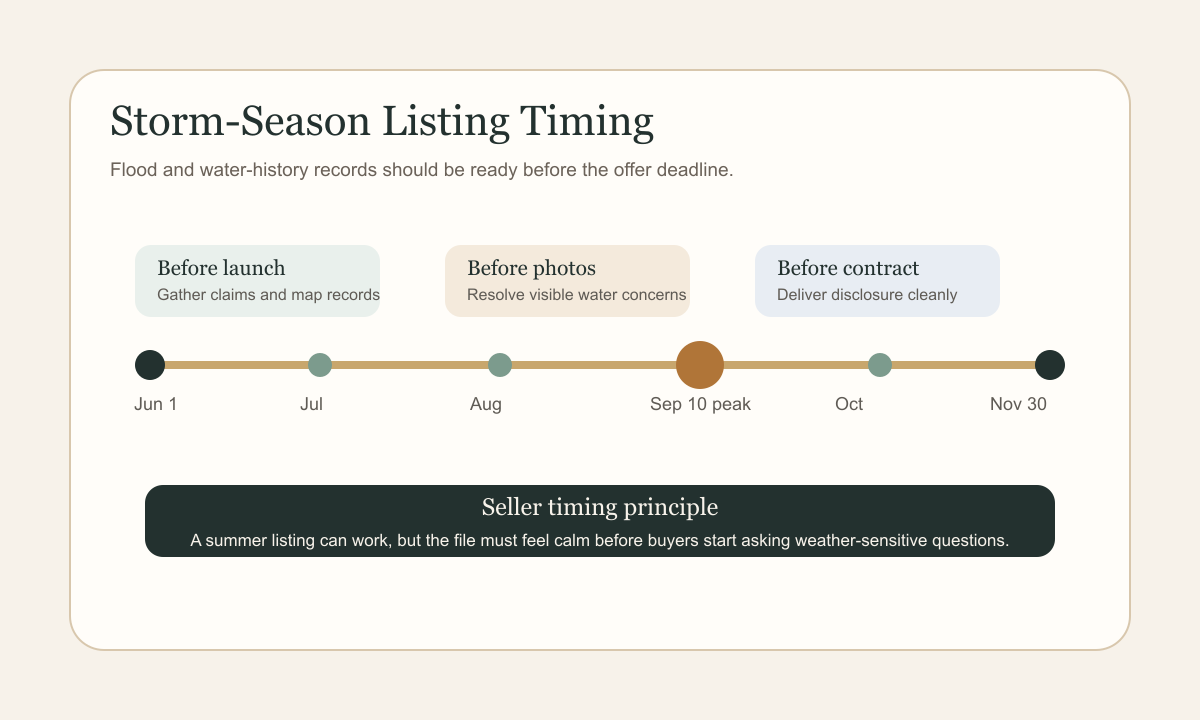 Hurricane season does not stop a well-prepared listing, but it does make flood, claims, and water-history answers more urgent before buyers reach contract stage.
For a Pinecrest seller, the storm-season file often sits next to the property's visual story. Mature canopy, larger lots, pools, patios, guest houses, and landscape features can be part of the appeal. They can also invite questions about tree maintenance, grading, yard drainage, and storm cleanup. If the property has an excellent record, say that carefully and document what you can. If it has a past issue, explain it consistently.
For a Kendall seller, the conversation may be more practical. Buyers comparing multiple homes around daily-drive corridors, school routes, or shopping hubs may be looking for the property that feels easiest to own. A clean file on claims, repairs, flood-zone context, and inspection-sensitive water history can help keep the home in the "manageable" category instead of the "needs more investigation" category.
The best timing is usually earlier than sellers expect:
| Timing window | Seller action | Purpose |
|---|---|---|
| Before pricing | Identify any known flood, water, or claims history | Pricing and prep should not assume a clean file if the file is not clean. |
| Before photography | Resolve visible water stains, drainage mess, debris, or exterior maintenance distractions | Photos should not invite avoidable inspection anxiety. |
| Before showings | Prepare a short, accurate explanation for known events | Buyer-facing language should be consistent. |
| Before contract | Confirm the disclosure answers and supporting documents | The statutory deadline should not feel rushed. |
A practical consultation packet for Joanna
When I think about this topic from a listing-strategy perspective, I would not start by asking, "Is this a flood house?" That framing is too blunt and often inaccurate. I would start with a property-specific packet that helps decide how much the issue matters for positioning, pricing, photography, buyer questions, and contract management.
Bring these items to a seller consultation if they apply:
- your best current understanding of any flooding that damaged the property during your ownership;
- flood-related insurance claim records, including NFIP claim details if relevant;
- FEMA or other flood-damage assistance records if any exist;
- elevation certificate or flood-zone documents already in your files;
- insurance declarations or agent notes that help explain flood coverage questions;
- invoices, permits, remediation notes, or contractor records for water-related repairs;
- notes on roof, window, door, garage, drainage, grading, or pool-deck issues that could affect buyer perception;
- and a list of what you do not know yet, so it can be verified rather than guessed.
That last bullet is underrated. A seller who says "I need to confirm that" is in a better position than a seller who improvises an answer that later conflicts with a form, repair invoice, or insurance record.
Joanna's seller page frames the selling process around valuation, strategic pricing, preparation, marketing launch, showings, offers, and closing. A flood-disclosure packet supports each of those steps. It may affect how a property is priced, whether certain repairs are worth doing before launch, how the home is photographed, what the showing script should avoid, and which questions should be directed to an attorney, insurance agent, surveyor, or contractor.
If you are also listing during late spring, summer, or early fall, pair this with Joanna's hurricane-season listing checklist. The flood-disclosure file is the paperwork side; the storm-readiness checklist is the visible-property side. Sellers need both when weather risk is already part of the buyer's mental filter.
The seller takeaway
The best seller posture is not defensive. It is prepared. Florida's flood disclosure asks a narrow set of questions, but Pinecrest and Kendall buyers may ask a wider set: flood zone, elevation, water intrusion, drainage, claims history, insurance, permits, and storm-season readiness. Those topics should not be left to memory.
If your file is clean, organize it so the clean story is easy to understand. If your file has history, organize it so the history is accurate, documented, and not exaggerated in either direction. If something is uncertain, identify the uncertainty early and ask the right professional before the buyer's deadline controls the conversation.
For most sellers, the next step is simple: pull the flood, claims, map, elevation, repair, and permit records you already have, then use Joanna's Market Insights library and a property-specific consultation to decide what needs action before launch. The goal is not to promise a risk-free house. The goal is to list with a record that feels as polished as the marketing.
This article is educational market guidance for sellers and is not legal, insurance, engineering, or floodplain advice. Disclosure duties, insurance requirements, map status, and repair decisions vary by property, so confirm your specific situation with the official source and qualified professionals before relying on it in a transaction.
Selling in ?
Get a free valuation or explore seller services in your area.