Pinecrest Pre-Listing Vendor Timeline: When to Book Repairs, Staging, and Photography
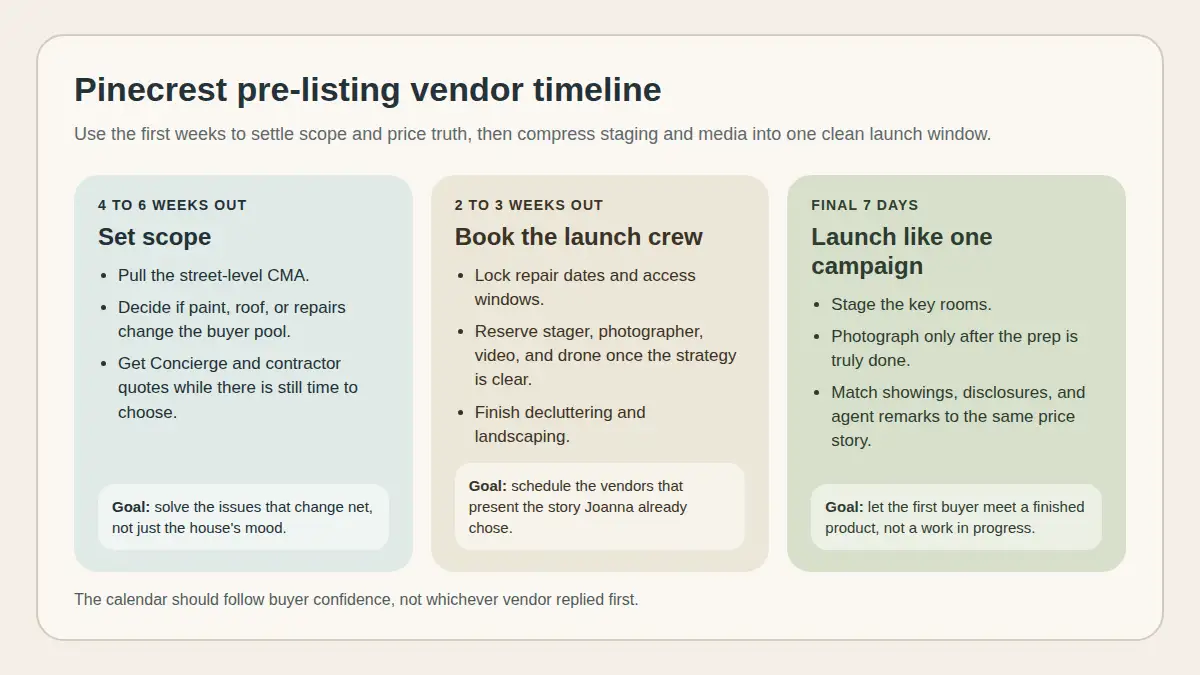
If you are mapping a Pinecrest pre-listing vendor timeline, the expensive mistake is usually not the wrong vendor. It is the wrong order.
Too many sellers book preparation work in the order contractors become available instead of the order the listing actually needs. Photography gets scheduled before the pricing lane is clear. A stager walks in before anyone has decided whether the buyer pool is paying for polish, privacy, or move-in ease. A large repair estimate arrives after the launch calendar is already locked. By then, the seller is not making calm strategic choices. The seller is reacting to the clock.
Joanna's sell page and her Pinecrest seller page both point to the same discipline: pricing, prep, marketing, and showing management work best when they are treated as one coordinated campaign rather than separate errands. In a market like Pinecrest, where one street can compete as a broad family move-up play and the next one trades on privacy, lot quality, or estate presentation, the timing of each vendor decision changes the seller's net just as much as the vendor choice itself.
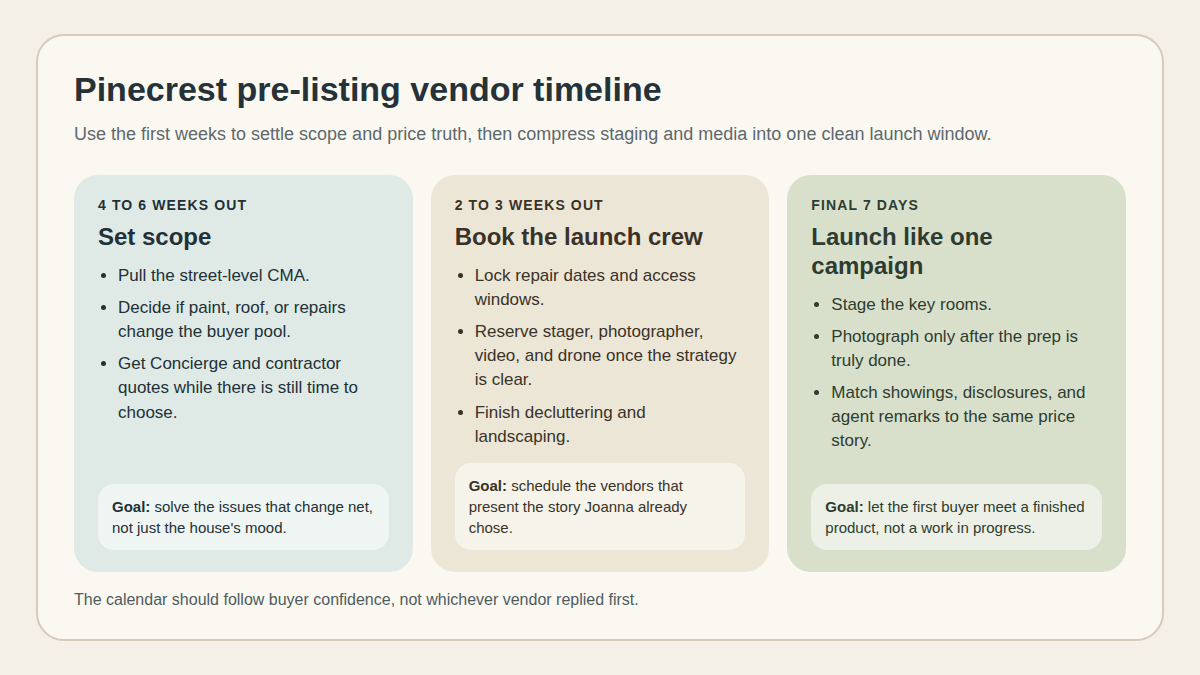 The smartest launch calendars settle scope early, lock the right vendors after pricing is clear, and save photography for the moment the home is truly ready.
Why vendor timing changes the seller's net, not just the calendar
A Pinecrest seller can lose money by over-improving, but a seller can also lose money by improving at the wrong moment.
Joanna's Pinecrest snapshot is useful here because it frames prep and staging as planning variables, not vanity extras. Her page says cosmetic work can live in the low-thousands while larger Concierge-backed items can be deferred to closing, but it also reminds sellers that their real net still has to absorb loans, credits, repairs, and the cost of any rushed decision. That is the difference between a prep budget and a prep strategy.
The timing question matters because different vendors solve different problems. Some work changes who the buyer is. Some work simply helps that buyer understand the product faster. If a roof concern, tired paint, or obvious deferred maintenance is going to make buyers discount the home before they ever engage with the lot or layout, that decision belongs early. NAR's 2025 remodeling coverage supports that logic: the top agent-recommended presale projects were painting the whole house, painting a room, and installing a new roof when needed, and the same report says 46% of buyers are less willing to compromise on condition. Those are not Pinecrest-specific guarantees, but they are useful discipline. Confidence killers should not wait until the photography week.
By contrast, some decisions only make sense after Joanna finishes the street-level CMA. Her Pinecrest market page and seller guidance both insist that 33156 is not one product. A house that is really selling on lot size, tree canopy, and privacy may need a different prep lane than a more value-driven family home that wins on clean updates and easy showing flow. That means the vendor timeline has to follow the pricing story, not the seller's stress level.
What to lock four to six weeks before pricing is set
The first phase is about truth, not polish.
Four to six weeks before a target launch, I would want the seller and Joanna solving the decisions that change scope, spend, and buyer confidence. This is where a consultation, vendor walk-throughs, and a pricing conversation belong in the same week if possible.
Start with the projects that can alter the final list-price conversation:
| Early decision | Why it belongs here |
|---|---|
| Roof or leak concern | Buyers price visible risk immediately, and roofing calendars rarely bend to a last-minute photo date. |
| Interior or exterior paint scope | Paint is one of the clearest confidence builders, but only when there is time to finish, cure, and restyle the rooms afterward. |
| Landscaping and curb-appeal work | Pinecrest buyers judge arrival quickly, especially when lot value and first impression are part of the ask. |
| Concierge quote or contractor estimate | Sellers need to know whether Joanna's team can coordinate the work through Compass Concierge or whether the project should stay smaller and faster. |
| Decluttering and storage plan | The staging plan gets sharper when oversized furniture, overflow closets, and family storage are handled early. |
This is also the right time to decide what kind of problem the house really has. If the gap is buyer trust, early work should focus on condition. If the gap is buyer imagination, the early work may be lighter and the later staging plan may do more of the lifting. Joanna's seller pages are strong on this point: the goal is not generic improvement. The goal is preparation that helps the correct Pinecrest buyer understand the home faster.
What I would not do in this first window is rush to book photography because a favorite vendor has one open date. Joanna's premium marketing package is valuable because it includes photography, video, twilight, drone work, and 3D tours. That is exactly why the media clock should start after the home looks the way the final listing intends to present it.
What should wait until Joanna finishes the street-level CMA
Some improvements feel urgent only because they are expensive.
That is where Pinecrest sellers can overspend. Joanna's 33156 guidance keeps repeating that the street matters more than the ZIP, and that applies to renovation scope too. Until the CMA tells you how the house needs to compete, it is hard to know whether a project is necessary, helpful, or simply emotionally tempting.
Major kitchen refreshes, large flooring replacements, custom built-ins, pool resurfacing, and more ambitious room reconfigurations usually belong in the "wait until pricing is clear" bucket. NAR's remodeling report is helpful here because even nationally admired projects do not all recover their cost equally. A steel front door, closet renovation, or vinyl windows may recover far more than sellers expect, while a larger luxury-minded renovation can still be the wrong move if the home is not going to be marketed as a fully transformed product.
That is why Joanna's micro-neighborhood approach matters. If the likely Pinecrest buyer is paying for lot, privacy, and long-term upside, a seller may not need to chase a full designer overhaul before launch. If the likely buyer wants a turnkey move and is comparing the house against cleaner, easier options, then a narrower set of high-visibility fixes could matter more than another round of custom wish-list work.
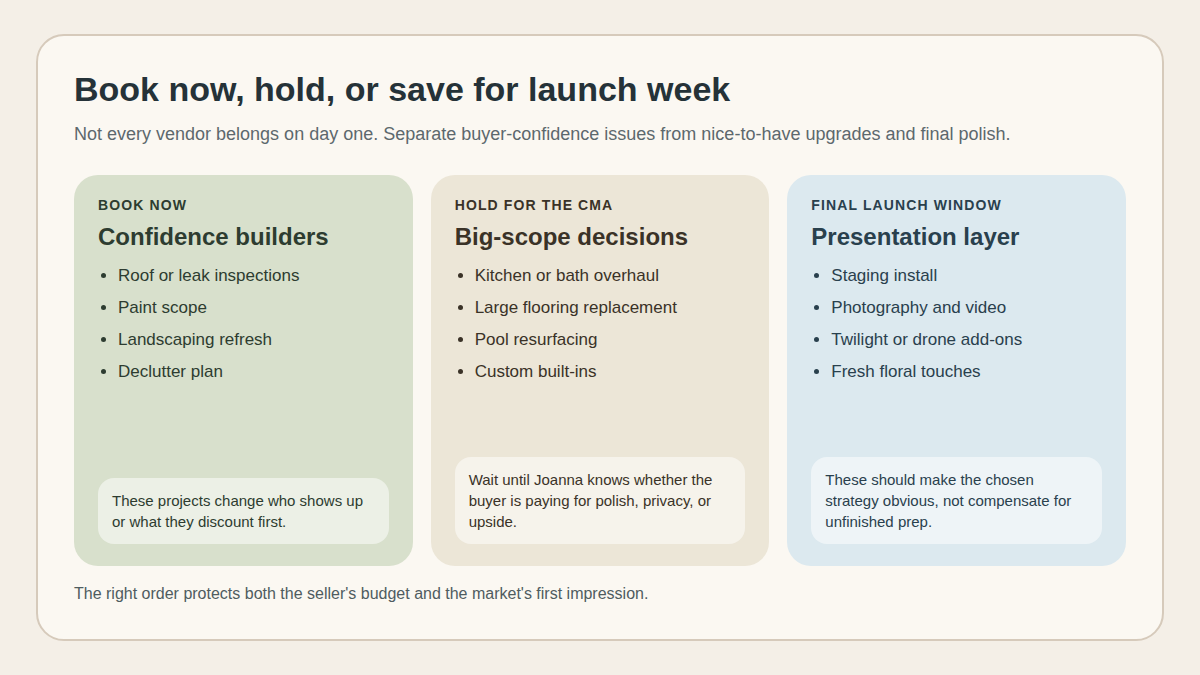 The smartest prep plans separate buyer-pool issues from expensive nice-to-haves. Not every vendor belongs on day one.
A simple question helps: does this project change who will show up, or does it only make the seller feel more finished? If it changes the buyer pool, price support, or condition confidence, decide early. If it mostly changes taste, wait until the CMA says that taste upgrade is essential.
How staging and photography should compress into the final launch window
Once pricing direction is set and the heavy decisions are made, the campaign should get tighter, not looser.
This is where many luxury sellers accidentally create drag. They stage too early, live through the staged house for weeks, then re-shoot. Or they photograph before the final paint touchups, landscaping cleanup, or furniture edits are done, which forces retouching or a second media day. A better sequence is to treat staging and photography as the final expression of the strategy Joanna already chose.
NAR's 2025 staging report gives a practical reason to respect that sequence: 83% of buyers' agents said staging made it easier for buyers to visualize the property as a future home, and the most commonly staged rooms were the living room, primary bedroom, and dining room. That supports a focused staging window. The point is not to stage every corner forever. The point is to make the rooms that tell the Pinecrest value story feel immediate and convincing when the photos go live.
In practice, the final launch window usually works best when it compresses into one clean run:
- Repairs and paint are finished.
- Deep cleaning, decluttering, and landscaping are complete.
- The stager installs for the rooms that matter most.
- Joanna's photo and video team captures the home once it is genuinely launch-ready.
- Showing instructions, agent remarks, and disclosure support are aligned to the same story.
That order matters because photography is not a decoration step. It is the moment the entire market meets the pricing thesis. If the thesis is "estate privacy with polished entertaining spaces," the rooms, light, landscaping, and twilight shots all need to support that. If the thesis is "clean Pinecrest entry point with easy family usability," the visuals should make that feel obvious without pretending the house is something else.
Which tasks belong in Concierge versus out-of-pocket prep
Compass Concierge is most useful when it protects seller liquidity without blurring the decision-making.
Joanna's pages describe Concierge as a way to front the cost of work like painting, staging, landscaping, and repairs with repayment at closing only if the improvements help the sale. For some Pinecrest owners, that is exactly what makes the right prep plan possible. But it still does not mean every available project deserves a green light.
I would think about the split this way:
Good Concierge candidates usually have three traits:
- They improve buyer confidence quickly.
- They are hard to ignore in photos or showings.
- They support the pricing lane Joanna is already defending.
That can include paint, targeted landscaping, selected repair work, and staging support. Those are often the items that help the listing feel finished without changing the underlying product.
Better out-of-pocket or hold decisions tend to be the projects where scope can drift: oversized remodel ideas, emotionally driven upgrades, and "while we're at it" expansions that do not clearly change the likely buyer response. Those are the projects most likely to eat time and attention while giving the launch calendar less clarity, not more.
The key is that Concierge should serve the strategy, not become the strategy. If Joanna's CMA and buyer-path analysis say the home wins with disciplined prep and a fast, polished launch, Concierge can help execute that. If the seller is using Concierge to postpone a hard pricing conversation, the timeline is already off.
What Joanna should verify before the first showing request
Before I would let the first Pinecrest showing request hit the calendar, I would want six questions answered cleanly.
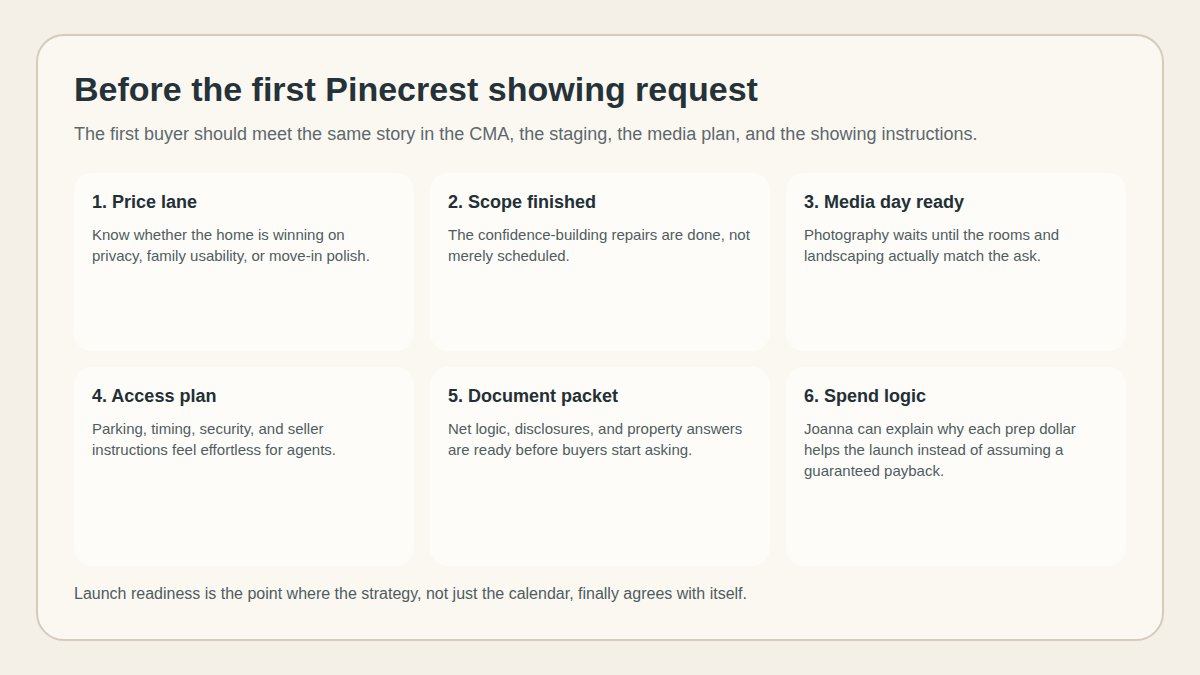 The first buyer should meet the same story in the CMA, the staging, the photos, and the showing instructions.
-
What is the real pricing lane?
Estate privacy, broad family appeal, or value-through-condition? Every vendor choice should reinforce that lane. -
Which project actually changes buyer confidence fastest?
Paint, roof, landscaping, decluttering, or a tighter staging plan? -
What got booked because it matters, and what got booked because it felt productive?
That difference is where prep budgets usually drift. -
Is the home fully ready for its only major media day?
Not mostly ready. Not photo-ready in the front but unfinished in the backyard. Ready. -
Are the showing instructions as polished as the photos?
Access, parking, timing, security, and seller expectations should feel effortless for buyer agents. -
Can Joanna defend the prep spend in a net conversation?
The seller should know how the work supports pricing, timing, and likely proceeds rather than treating every dollar as automatically recoverable.
That is the real advantage of a disciplined Pinecrest pre-listing timeline. It reduces last-minute scrambling, but more importantly it keeps the pricing story, the prep story, and the marketing story from arguing with each other.
If you already know your likely launch season, Joanna's Pinecrest listing consultation checklist is useful for the first-meeting phase, and her Compass Concierge analysis helps when you are deciding how to fund prep. The stronger move, though, is to map the vendor calendar only after you know which buyer the house is supposed to attract first and which prep work truly helps that story land.
This article is educational real-estate commentary, not appraisal, legal, lending, tax, insurance, or contractor advice. Vendor availability, prep budgets, and buyer response vary by property and market conditions, so confirm the decisions that matter for your home before relying on this guidance in a sale.
Selling in Pinecrest?
Get a free valuation or explore seller services for ZIP 33156.