Pinecrest Listing Consultation Checklist for Luxury Estate Sellers
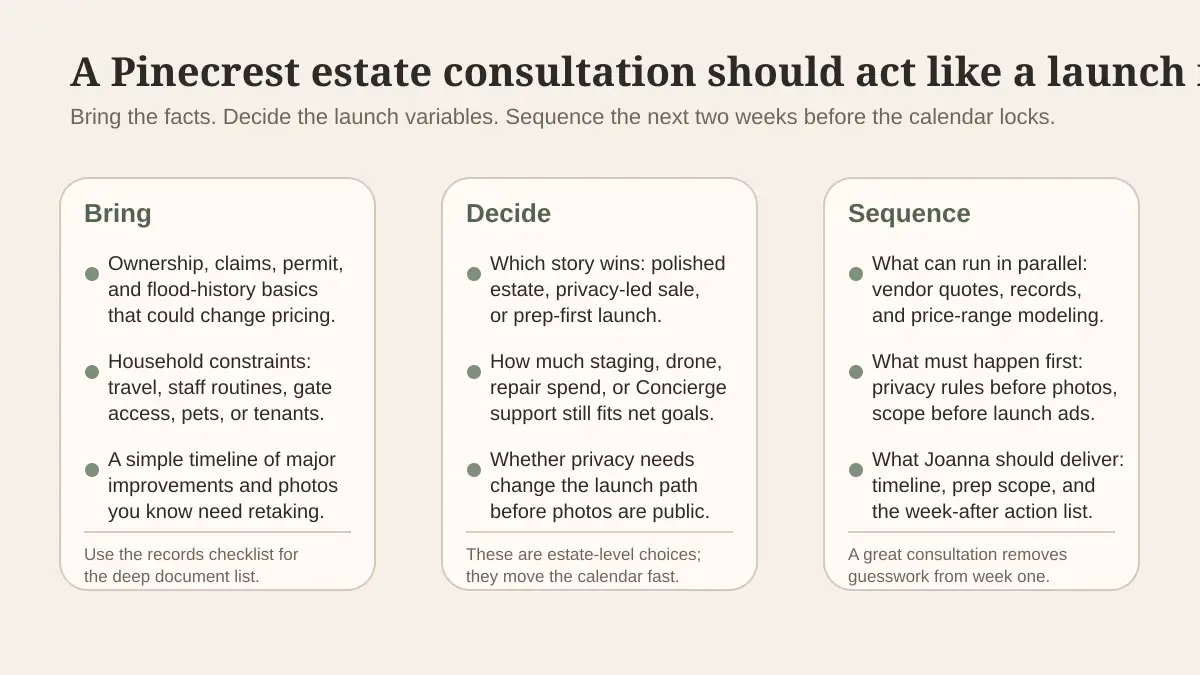
A strong Pinecrest listing consultation checklist for estate sellers does not start with, "What is my house worth?" It starts with a more useful question: what has to be clear before pricing, staging, photography, and privacy decisions are allowed to move forward together? If the first meeting becomes a scavenger hunt for permits, flood-history details, gate-access rules, or half-finished project notes, the strategy conversation gets pushed into a second meeting that should not have been necessary.
That is especially true in Pinecrest, where Joanna Jimenez's live seller page and Pinecrest seller page both frame the process as far more than a quick estimate. The current pages lead with luxury-team credentials, a $500M+ career-sales track record, a 98% list-to-sale ratio, and a six-step selling process that moves from consultation and pricing into preparation, premium marketing, showings, and closing coordination. On estate-level homes, that means the consultation should feel like a launch meeting, not an intake form.
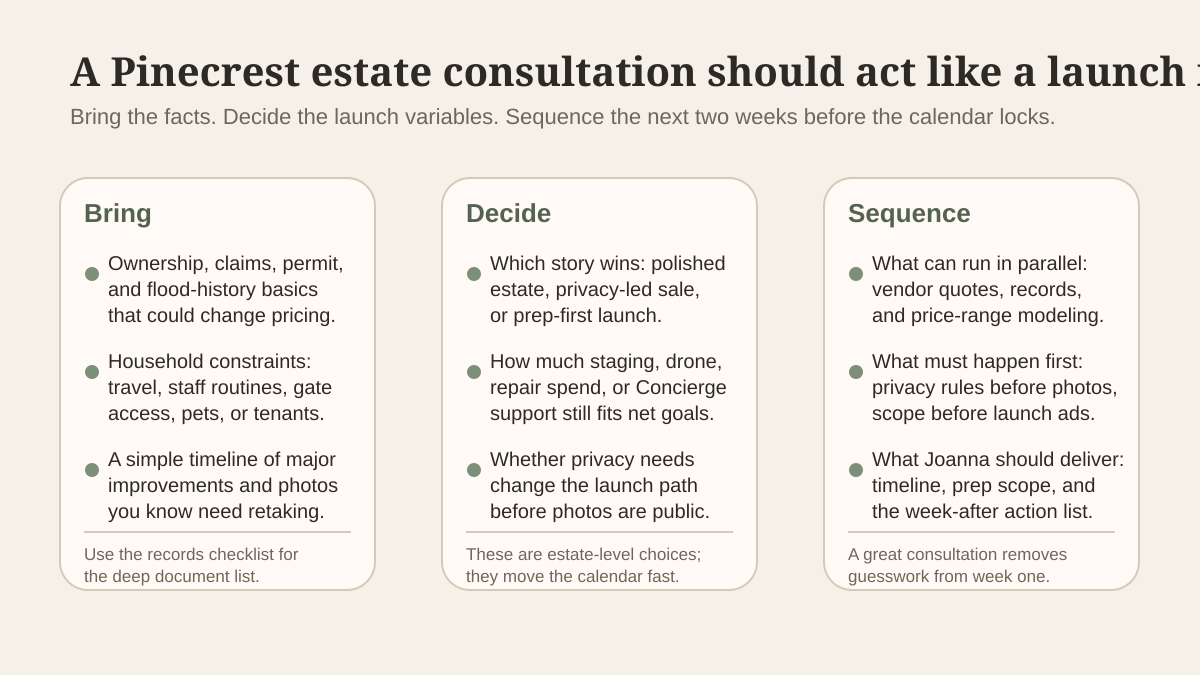 The first meeting should leave you with a launch path, not a longer list of unanswered questions.
Why a Pinecrest estate consultation should feel like a launch meeting
Pinecrest sellers do not all face the same launch problem. Joanna's About page leans hard into micro-neighborhood expertise, premium marketing, and buyer-specific positioning. Her Pinecrest page adds the practical version of that promise: North/South differences, lot-size variation, staging support, twilight and drone photography, and transaction management from a 20-person team.
In other words, the consultation is not there only to tell you whether the home is expensive. It is there to answer questions that change the entire prep calendar:
- Is this home going to compete as a polished, move-in-ready estate, or as a property where setting and privacy matter more than full cosmetic perfection?
- Which improvements deserve money, and which only create noise?
- Does the household need a broad public launch, or does discretion deserve a real discussion before the listing goes live?
- Can staging, documentation cleanup, and photography happen in parallel, or are there sequencing issues that make one step depend on another?
That is why estate sellers should resist treating the consultation like an appraiser's appointment. Joanna's live selling process starts with consultation, moves into pricing and preparation, and only then shifts into market launch. If the first meeting does not clarify those handoffs, the home may still list, but the launch often feels reactive instead of intentional.
What to bring so the first meeting stays strategic
You do not need to bring every record imaginable to the first meeting. Joanna's existing seller records checklist is the better place for the deep paperwork pass. The consultation works best when you surface the categories that actually change launch decisions before the calendar starts filling with vendors and photo dates.
For estate sellers, four buckets usually matter most:
- Ownership and signer clarity. If a trust, LLC, spouse, heir, or multiple co-owners will have to approve decisions, say that at the beginning. Strategy slows down when the right people are not in the room or do not know what will need their signature later.
- Improvement history with rough dates. You do not need a perfect archive. You do need a clean story about roof work, impact windows, pool updates, generator installation, HVAC replacement, guest-house work, or major landscaping changes.
- Flood and claims context. Florida's current flood-disclosure statute requires sellers to provide a flood disclosure at or before contract execution, including prompts about known flooding, flood-damage claims, and FEMA assistance. That does not mean the consultation becomes legal advice. It does mean flood history should be organized early, not reconstructed under contract pressure.
- Operational constraints inside the home. Estate sellers often forget that family routines, housekeepers, pet schedules, gate codes, live-in relatives, summer travel, and school-year timing can affect showing rules and photo scheduling just as much as the permit file does.
The useful test is simple: if Joanna asks, "What would slow us down after we agree on pricing?" you should be able to answer in one page or less. Missing documents are manageable. Hidden constraints are what turn a smooth launch into a messy one.
The estate-level decisions that change pricing and prep
Luxury consultations get more valuable when they force a seller to make decisions, not just collect homework. Joanna's seller pages already promise micro-neighborhood pricing, premium marketing, Concierge-supported improvements, and a coordinated team. The consultation should translate those promises into choices.
| Decision to make early | Why it changes the launch |
|---|---|
| How polished the home really needs to be before photos | Estate buyers notice mixed signals fast. If the home needs cosmetic work, landscaping cleanup, or a tighter room story, that should be priced into the calendar immediately. |
| Whether Compass Concierge is a fit or a distraction | Joanna's live seller pages describe Concierge as a way to front the cost of improvements without upfront payment. That can be useful, but only when the scope is clear and the payback logic is disciplined. |
| How much privacy the household actually needs | Privacy can affect photography choices, showing instructions, sign placement, and whether the launch path should stay public, phased, or more discreet. |
| What buyer story the home is trying to win | Some Pinecrest estates sell on privacy and grounds, others on turnkey polish, school-adjacent convenience, or multi-generational flexibility. That story should guide prep instead of being invented after the photo shoot. |
Notice what is missing from that table: vague promises. A good consultation is not where an agent tells you every improvement "adds value." It is where the seller and agent decide which improvements support the pricing story, which only protect against objections, and which should be skipped because they burn time without clarifying the home's position.
That is also where the estate-level distinction becomes real. Smaller or more standardized homes can sometimes move with a looser plan. Estate homes rarely do. They have more variables, more vendor touchpoints, and more ways to send conflicting signals if the plan is not explicit.
How to sequence vendors, staging, and photography
The most common scheduling mistake is assuming every prep task should begin at once. Some work can overlap. Some should not.
Joanna's Pinecrest page lays the sequence out clearly: consultation, pricing strategy, preparation and staging, then the premium marketing launch. That sounds obvious until a seller books photographers before deciding whether a room will be staged, or invites landscapers and painters before anyone has agreed on what the final price story is supposed to be.
A better sequence looks like this:
- First: lock the pricing lane, the buyer story, and any privacy rules that affect what can be photographed or shown.
- Second: decide the prep scope - what is mandatory, what is optional, and whether a program like Concierge should be considered.
- Third: stage and photograph against the actual plan, not against the seller's vague memory of how the house normally lives.
- Fourth: set the launch window only after the first three pieces are aligned.
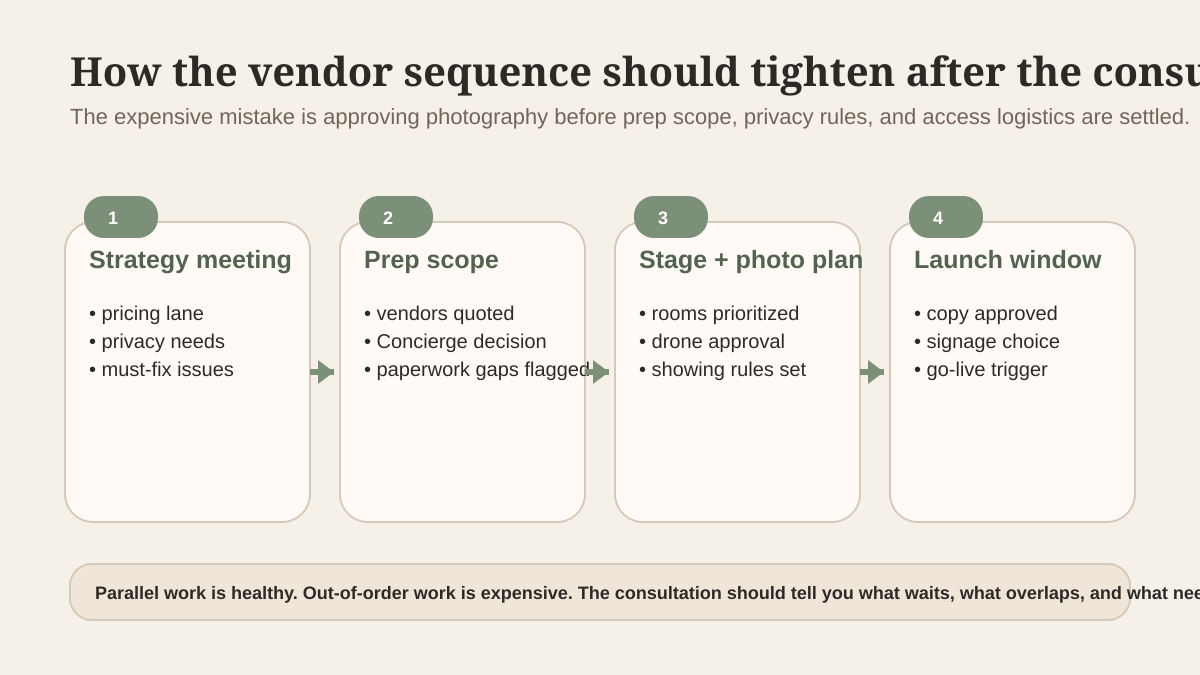 Parallel work is healthy. Out-of-order work is expensive.
This is where Joanna's team structure matters. A seller should ask who coordinates what. Is one person handling staging recommendations while another chases photography, sign-off copy, and showing rules? Who owns the calendar? Who tells the seller when the home is actually market-ready?
For estate sellers, that coordination matters because the vendor list is usually longer than owners expect. Even a restrained launch may involve cleaners, landscapers, stagers, photographers, drone operators, handymen, painters, pool vendors, or gate-access coordination. If the consultation ends without clarity on the order of operations, the calendar starts leaking time the next morning.
When privacy should change the launch plan
High-end sellers often assume privacy automatically means off-market. Joanna's existing off-market Pinecrest guide is more disciplined than that. It says private selling can make sense for privacy requirements, unique properties, testing the market, or time-sensitive situations - but it also says broad exposure is often better when maximum competition is the priority.
That is the right frame for a consultation. Privacy should change the launch path when the reason is real, not when it simply sounds prestigious.
Compass makes a similar argument on its public Private Exclusives page. The page says sellers can test price, gather insights, and share a listing inside Compass's network before it goes public, with access to 340,000 in-network agents and serious buyers. That can be useful when a household is still finishing prep, when public attention would be disruptive, or when the seller wants an early signal before broad syndication.
But the same consultation should also ask the uncomfortable question: what do we lose if we limit exposure? Public launches can create more competitive tension. Private launches can protect discretion, but they also narrow the first wave of eyes on the property. The answer depends on the seller's priorities, not on a luxury cliché.
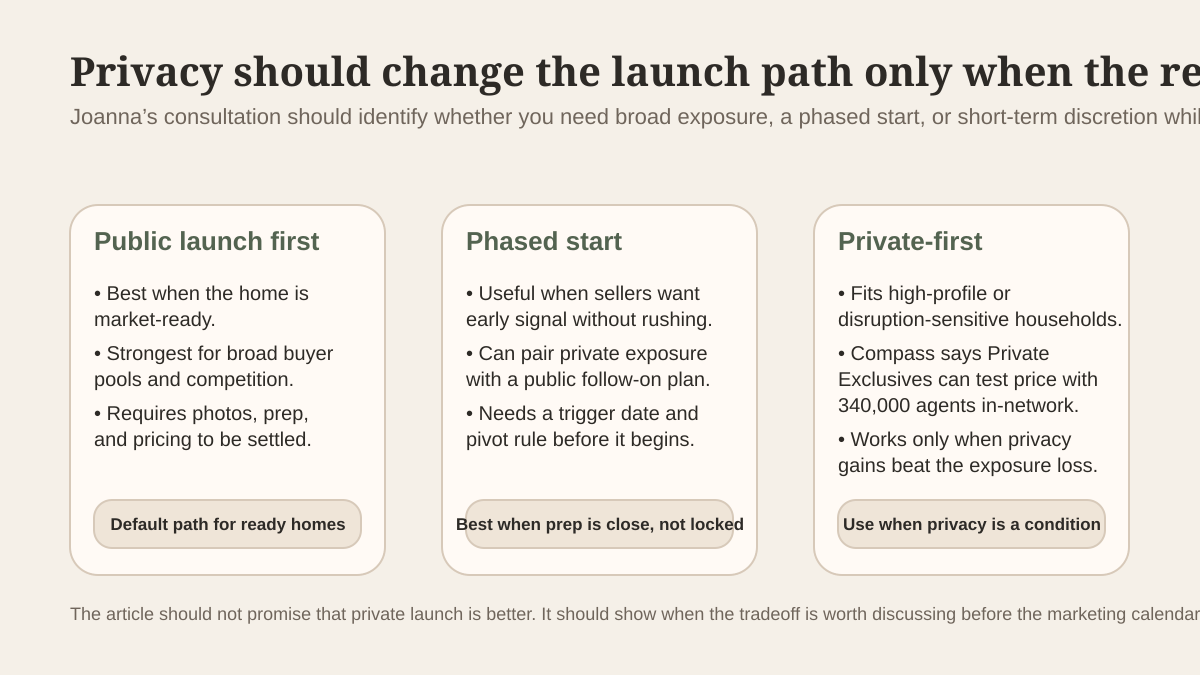 Privacy is a real strategy variable. It is not automatically the winning one.
For that reason, a seller should leave the consultation with a trigger, not just a preference. If the plan begins privately, what would make Joanna recommend a public launch two weeks later? If the plan begins publicly, what guardrails protect family routines and showing logistics? If the answer is still fuzzy, the launch path is not ready yet.
Questions to ask Joanna before the calendar gets locked
A strong consultation usually gets better when the seller arrives with sharper questions than, "What do you think?" These are better prompts:
- Which Pinecrest comps are true peers for my micro-pocket and buyer profile, not just my ZIP code?
- What prep items are value-protecting, and which are only cosmetic theater for this price band?
- If we discuss a phased or private start, what is the exact trigger for going public?
- What has to be solved before photography, and what can still be in motion afterward?
- Which vendors should move in the first week, and who coordinates them?
- What written deliverables should I expect after this meeting - price range, prep scope, launch calendar, documentation follow-up, or all four?
Those questions do two useful things. First, they force the agent to show whether the plan is actually specific. Second, they help the seller compare one consultation against another without getting distracted by generic confidence.
What should happen in the week after the consultation
The week after the meeting should feel calmer, not more confusing. A strong estate consultation usually produces a short list of deliverables:
- a recommended pricing lane or at least a narrower decision range;
- a prep list separated into mandatory, worthwhile, and skip-it items;
- a vendor and photography sequence with real dates or date targets;
- a documentation follow-up list for flood, permit, claim, or ownership issues that still need verification;
- and a launch recommendation that explains whether broad exposure, a phased rollout, or a more private start fits best.
If that follow-up never arrives, the consultation was probably too general. Joanna's live positioning is built around detailed market knowledge, premium marketing, and full-service execution. Sellers should expect the written plan to reflect that.
If you are preparing to sell an estate in Pinecrest, the best next step is to schedule the consultation before the calendar gets crowded with ad hoc vendor work. Use Joanna's seller pathway or the direct contact details on her live site - phone (305) 302-6384 and email joanna.jimenez@compass.com - so the first meeting can focus on launch decisions instead of information cleanup.
This article is educational and is not legal, tax, insurance, or valuation advice. Disclosure rules, flood forms, marketing programs, and launch strategy choices can change, so confirm the details on the live site and with the appropriate professionals before relying on them in a transaction.
Selling in ?
Get a free valuation or explore seller services in your area.