Gated vs Non-Gated Pinecrest Homes: How Sellers Should Price Privacy and Access
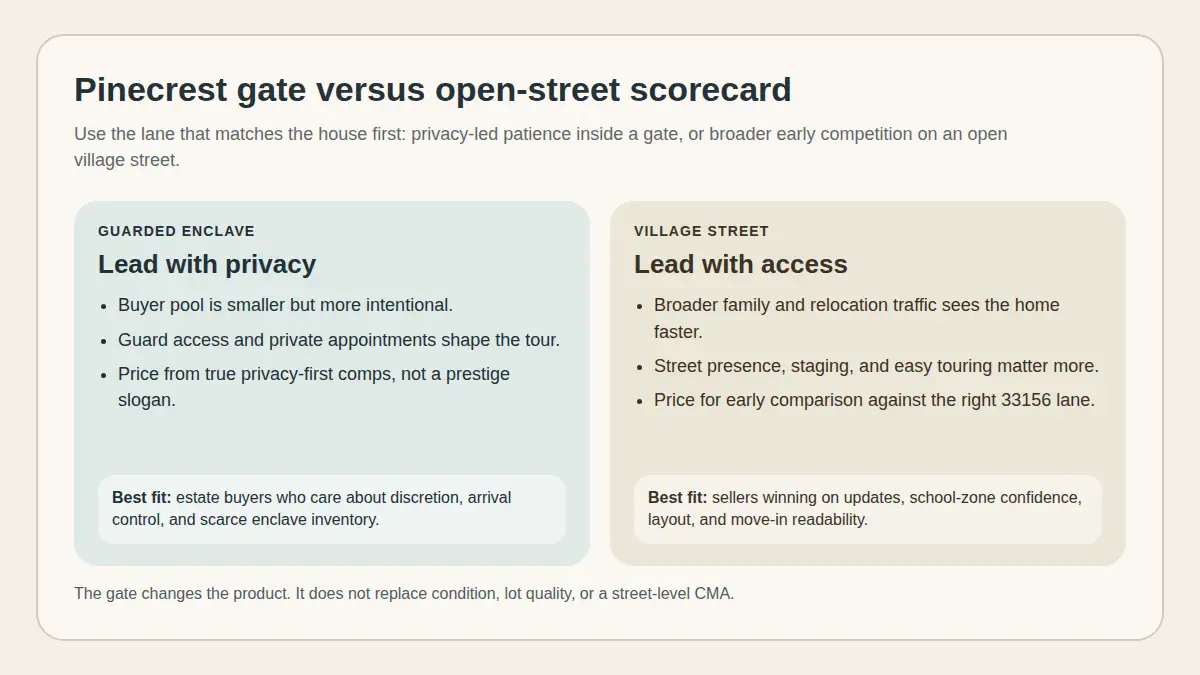
If you are pricing gated vs non-gated Pinecrest homes, the expensive mistake is assuming the gate itself writes the value story for you.
It does not.
A gate changes the product, but it does not erase the rest of the product. Joanna's Pinecrest seller page makes that clear: Pinecrest still has to be priced at the street and micro-neighborhood level, not from a ZIP-wide average and not from a prestige label alone. In real life, one guarded enclave may justify more patience because privacy, architecture, and access control are exactly what the right buyer wants. Another home on a broad non-gated street may pull stronger first-week feedback because more families can picture the school run, the lot, and the move-in path immediately. Both can be excellent listings. They are just sold through different forms of clarity.
Joanna's gated-community guide is useful because it frames the tradeoff honestly. Gated enclave listings typically mean a smaller, privacy-first buyer pool, more showing logistics, more discretion in the marketing, and more patience around the right match. Non-gated village streets usually mean broader Pinecrest demand, easier access, more drive-by and open-house energy, and faster market feedback. That does not make one better than the other. It means the list price, photo strategy, and launch plan have to match the lane the house is truly in.
 The pricing question is not whether the gate sounds prestigious. It is whether privacy, access, and buyer-pool width point to the same launch strategy.
Why gated vs non-gated is a pricing problem, not a status label
Pinecrest is affluent enough that broad ZIP context can fool sellers into thinking every property inside 33156 should behave the same way. It should not.
Census Reporter puts 33156 median household income at $137,076, median owner-occupied value at $1,120,100, and adults with a bachelor's degree or higher at 65.7%. That tells you the ZIP has deep buying power, established households, and a strong professional base. It does not tell you how a particular listing should be introduced to the market. Joanna's Pinecrest pages repeat that distinction over and over: 33156 is context, not your comp set.
That matters even more when the conversation turns to gates. A seller will sometimes say, "We are behind a gate, so we should ask more." Sometimes that instinct is directionally right. Sometimes it hides the bigger question: what exactly is the buyer paying up for?
In North Pinecrest, Joanna describes a product centered on estate lots, privacy setbacks, Pinecrest Gardens proximity, and the Gulliver walk conversation when it is actually true on the map. On some streets, the gate is one more layer on top of an already scarce estate product. In that situation, discretion and access control can strengthen the story. But a gate cannot rescue an overreaching price if the house still needs obvious work, the lot reads smaller than the seller thinks, or the buyer pool is narrow enough that the listing has to be patient from day one.
On the non-gated side, the mistake runs the other way. Sellers sometimes talk down the open-street product because it does not have a guarded entry. Yet Joanna's South Pinecrest page shows why broader access can be a real advantage. School-focused families, move-up buyers, and dual-income households often compare renovation quality, layout, and value-to-location faster when the home is easy to see, easy to understand, and easy to share with other decision-makers.
So I would frame the question this way: is the property's real advantage privacy and controlled access, or is it buyer-pool width and cleaner first-week competition? That answer should do more work than the word gated ever will.
When gated privacy deserves premium messaging
Some Pinecrest homes absolutely should lead with privacy.
If the listing sits in an enclave where limited turnover, guarded entry, deeper setbacks, and architectural consistency are all part of the reason buyers want the address, then the marketing should say that with confidence. Joanna's gated-community guide makes the seller implication explicit: the buyer pool is usually smaller, but it is more intentional. These are not casual Sunday browsers. They are often buyers who already know the difference between a general Pinecrest address and a home inside a controlled-entry pocket.
In those cases, I would not market the property as though it needs maximum foot traffic to succeed. I would market it as a scarce product that rewards the right match. That changes the tone of the copy, the photo sequence, and sometimes even the order of operations. You may protect more detail for qualified conversations. You may prioritize private appointments over broad-event energy. You may spend more time proving privacy, lot quality, and arrival experience than talking about generic village prestige.
But premium messaging only works when the house supports the promise. NAR's April 2025 coverage of the Remodeling Impact Report says 46% of buyers are less willing to compromise on home condition. That is a useful reminder for luxury sellers. A guarded entry does not exempt a listing from kitchen fatigue, roofing questions, aging systems, or tired outdoor spaces. If the house is supposed to attract privacy-first estate buyers, it has to feel like a privacy-first estate product when they arrive.
This is where pricing discipline matters most. I would not ask for a mystery premium just because the home is harder to access. I would ask whether the gate is paired with the lot, condition, and showing experience that make patience defensible. If the answer is yes, premium language can be earned. If the answer is no, the gate may still matter, but it cannot carry the number by itself.
When broader non-gated access wins the first week
The strongest open-street Pinecrest listings usually win because they remove friction.
A non-gated home can still be highly private, beautifully landscaped, and strategically positioned. It simply reaches buyers differently. Joanna's area pages describe this well: some Pinecrest sellers are really competing on school-zone confidence, renovation quality, lot usability, and how easy the home feels for family life. When that is the real product, broader access is not a downgrade. It is an asset.
That matters in the first week because more people can absorb the listing quickly. Street presence is legible. The arrival experience is simpler. Buyer agents can coordinate around school, work, and family schedules without a gate protocol becoming part of the conversation. For many owners, that wider funnel leads to faster truth about price.
NAR's May 2025 article on staging to sell says 83% of buyers' agents reported that staging helped buyers visualize the property as their future home. The same article says 58% of real estate professionals had seen buyers disappointed when homes they toured did not live up to the polished expectations shaped by TV-style design culture. That is exactly why non-gated Pinecrest sellers should not waste their main advantage. If buyers can get in easily, the home should reward that access immediately with clean presentation, clear room use, and a believable move-in story.
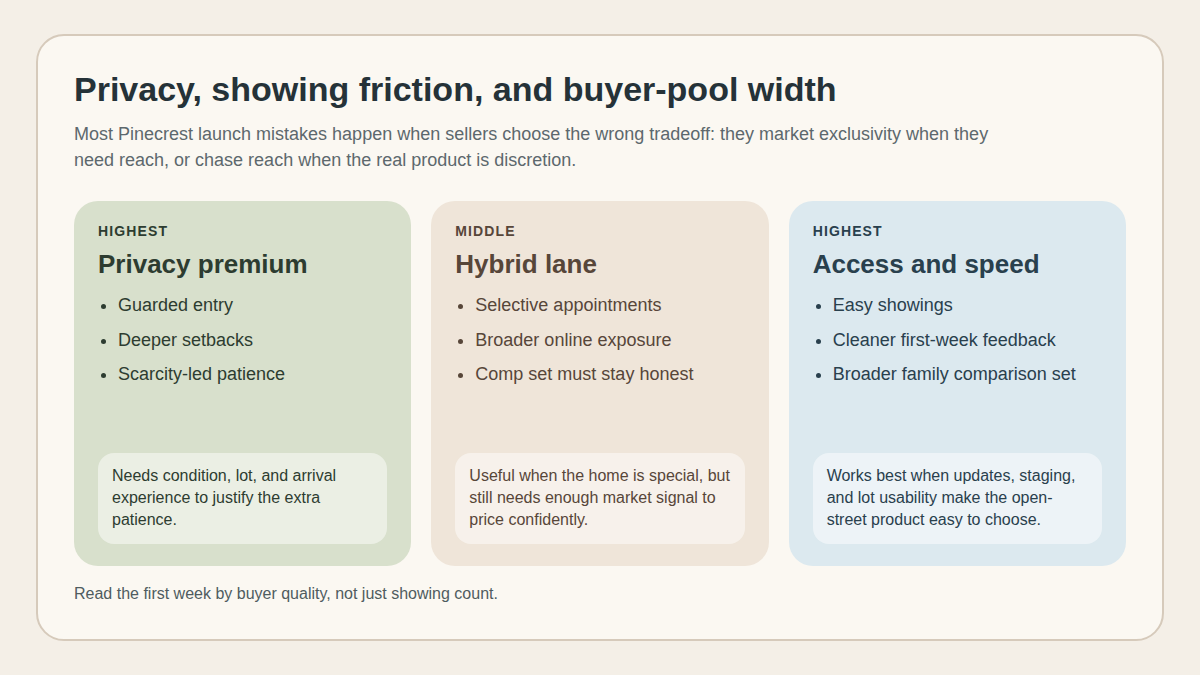 Open-street Pinecrest homes often compete best by making the first showing easy, polished, and legible for a broader family-and-relocation buyer pool.
This is especially true when the home is more value-driven than trophy-driven. Joanna's South Pinecrest guidance points to families and move-up buyers who are weighing updates, newer construction, and price-to-value rather than shopping only for discretion. In that lane, broader access helps the market do its work. You want more eyes, more shared feedback, and less ambiguity about how the house compares to other options in the same range.
So if the best thing about the home is not exclusivity but readiness, usability, and a smart 33156 entry point, I would lean into that. Let the gate conversation belong to homes that actually need it.
How showing logistics change the first week of market feedback
The first week on market is where gated and non-gated strategy separates most clearly.
A guarded or appointment-heavy listing usually produces slower, narrower feedback at the beginning. That is not automatically a red flag. It may simply reflect the product. But it does mean the seller has to understand what kind of signal they are waiting for. With fewer casual previews and fewer spontaneous drop-ins, each showing matters more. The house has to present fully. The gate protocol has to feel smooth rather than inconvenient. And the pricing has to be close enough to reality that the right buyer does not treat the friction as a reason to delay.
Open-street Pinecrest homes are different. Because access is easier, the market often tells you faster whether the ask is aligned. More buyers can see it. More agents can compare it. More families can test whether the layout, updates, and location fit the move they are trying to make. That wider signal can feel noisy, but it is useful. It helps Joanna and the seller learn whether the listing is broad enough to invite competition or still too dependent on a story the house does not fully support.
What I would avoid in either lane is reading the wrong metric. A privacy-led listing should not panic because it had fewer early showings than an open-street property. A broad-access listing should not celebrate traffic if the feedback says the condition or price still is not landing. The question is not raw showing count. The question is whether the first week is attracting the kind of buyer the price assumed.
The prep list that keeps discretion from becoming friction
Before launch, I would want a Pinecrest seller to settle the issues that most often turn good positioning into avoidable friction.
Start with pricing truth. Joanna's Pinecrest pages are right to insist on a micro-neighborhood CMA. If the house is gated, confirm that the comp set is actually pulling from comparable guarded or privacy-first product where possible. If it is not gated, do not borrow trophy-enclave logic to justify a number the broader street will not defend.
Then move to condition truth. NAR's remodeling coverage says the top agent-recommended presale projects were painting the entire home, painting one room, and installing a new roof when needed. That should sound familiar to Pinecrest sellers because it is usually the simple, confidence-building work that changes the audience first. Buyers forgive fewer condition questions when a listing is already asking them to accept restricted access, narrower inventory, or a thinner pool.
Next comes access truth. If the property is behind a guard or gate, the appointment process should feel polished. Visitor instructions, vehicle entry, guest approval, and timing should all be clear before the first showing request. If the home is on an open street, the same discipline applies differently: curb appeal, arrival sequence, parking ease, and the first thirty seconds from the street all carry more weight because more buyers will experience them quickly.
After that, settle documentation truth. School assignment, flood context, survey acreage, HOA or community rules, and any improvement history should be ready to discuss accurately. Joanna's Pinecrest pages repeatedly warn against canned school or flood claims, and that warning matters even more in a luxury market where buyers expect clean answers.
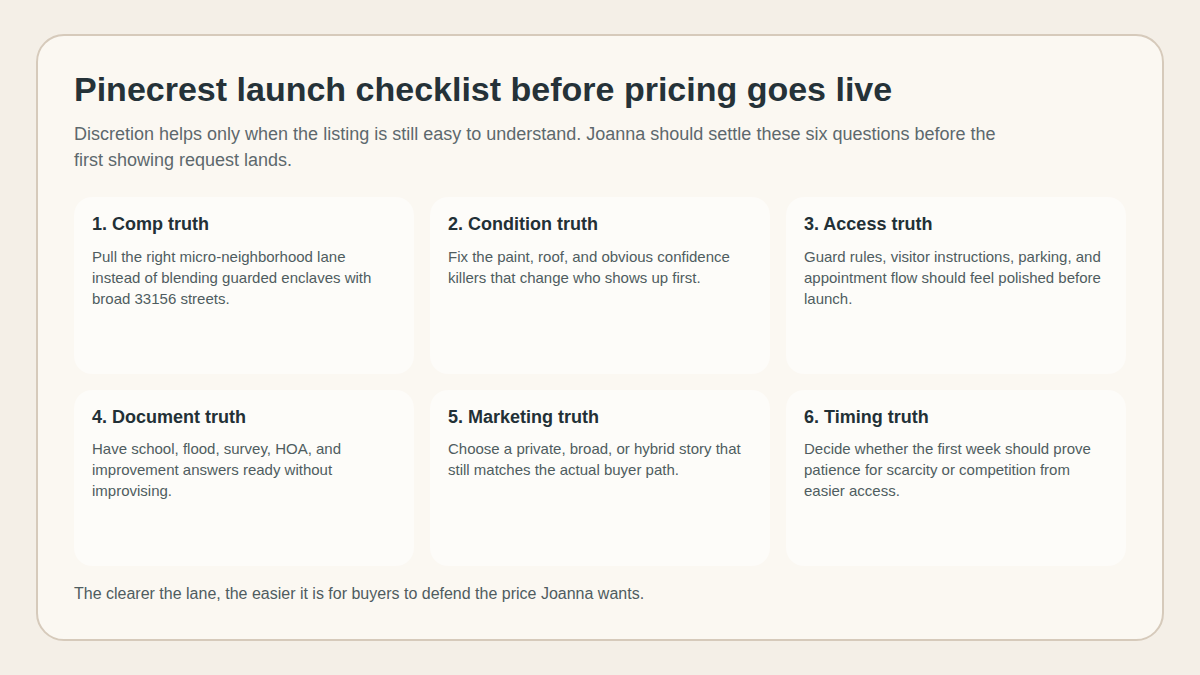 Discretion only helps when the listing is easy to understand for the buyer Joanna actually wants first: private-estate, family move-up, or both.
Finally, settle marketing truth. If the strategy is discretion, the materials should still feel complete for qualified buyers. If the strategy is wider access, the listing should look finished enough to justify the attention it invites. In both cases, clarity beats theater.
What Joanna should verify before launch
Before I would launch a Pinecrest listing through either lane, I would want six questions answered clearly:
-
Is the gate the product, or just one feature of the product?
If privacy, scarcity, and controlled access are the main reasons a buyer chooses the home, price and messaging should reflect that. If not, do not let the gate dominate the story. -
Which comp set actually matches the buyer experience?
Guarded enclave, broader estate street, South Pinecrest value lane, or another micro-market within 33156? -
What does the first week need to prove?
Patient qualification for a narrow buyer pool, or fast market confirmation from a broader one? -
Which condition issue changes the buyer pool fastest?
Paint, roof, kitchen fatigue, dated baths, outdoor wear, or simply a home that does not yet photograph like the price it wants? -
What access or rule question will buyers ask first?
Gate entry, appointment rules, parking, HOA oversight, school assignment, flood context, or lot boundaries? -
Does the marketing tone match the real strategy?
Private and selective, broad and polished, or a deliberate hybrid that still makes sense from the first photo to the first showing?
That is usually where the best Pinecrest pricing strategy lives. Not in a generic status label. Not in the assumption that every guarded home deserves a premium. And not in the idea that open access means a house is somehow less special.
The winning move is simpler: match the list price and launch plan to the kind of buyer the house can honestly attract first. If you want a property-specific strategy session, Joanna's Pinecrest market page and North Pinecrest overview are useful starting points, but the real leverage comes from pricing the street, the gate, and the condition together before the listing ever goes live.
This article is educational real-estate commentary, not appraisal, legal, lending, insurance, school-assignment, HOA, or flood advice. Buyer response, privacy value, access friction, and timing vary by property and market conditions, so confirm the details that matter for your home before relying on this guidance in a sale.
Selling in Pinecrest?
Get a free valuation or explore seller services for ZIP 33156.