South Pinecrest vs Palmetto Bay Sellers: How Border-Zone Homes Should Position Differently
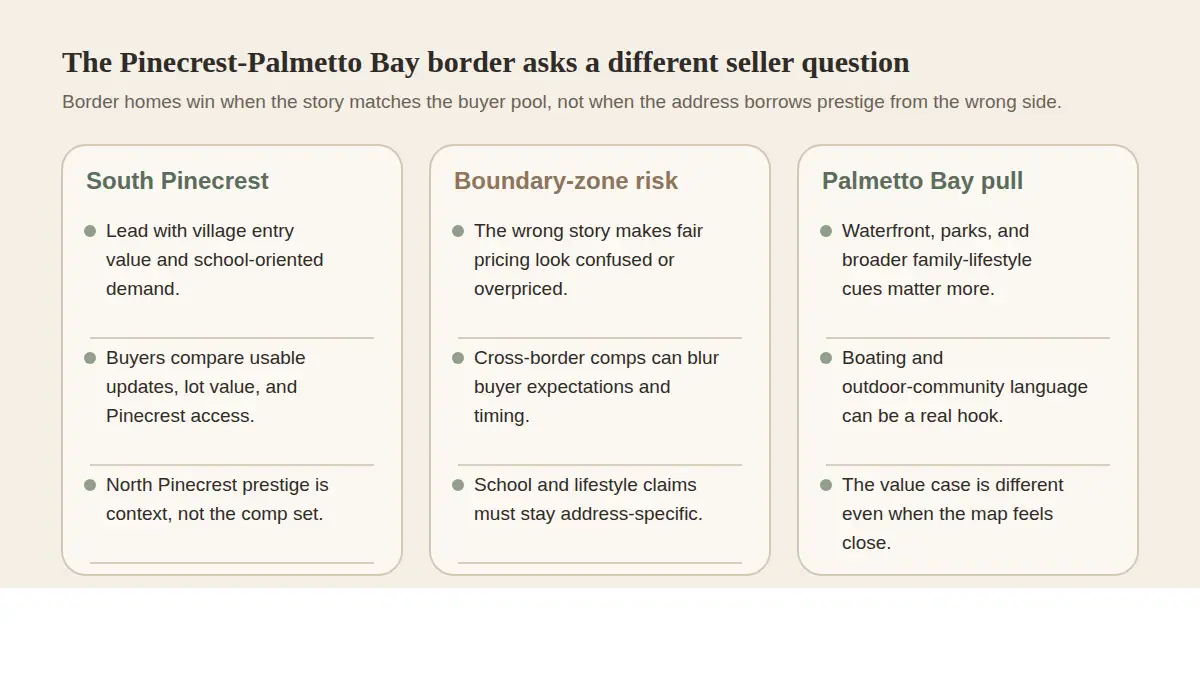
A useful South Pinecrest vs Palmetto Bay sellers guide starts with one uncomfortable truth: homes near that village line are often mispriced before the sign ever goes up. Not because the owner is careless, but because the home gets described with the wrong market story. The address may be in Pinecrest, yet the buyer may be comparing the property to family-lifestyle options in Palmetto Bay. Or the house may sit close enough to the boundary that a seller starts borrowing North Pinecrest prestige language even though the real value case is more about updates, schools, lot utility, and practical entry into village living.
That distinction matters because Joanna's Pinecrest market page and her South Pinecrest page already make clear that 33156 is not one flat pricing conversation. South Pinecrest is its own value-driven micro-market. At the same time, Joanna's broader market positioning for Palmetto Bay points toward a different emotional hook: waterfront living, outdoor community amenities, and strong school-oriented family appeal. If a border-zone seller blurs those two stories together, buyers usually feel the confusion before the seller sees it in the feedback.
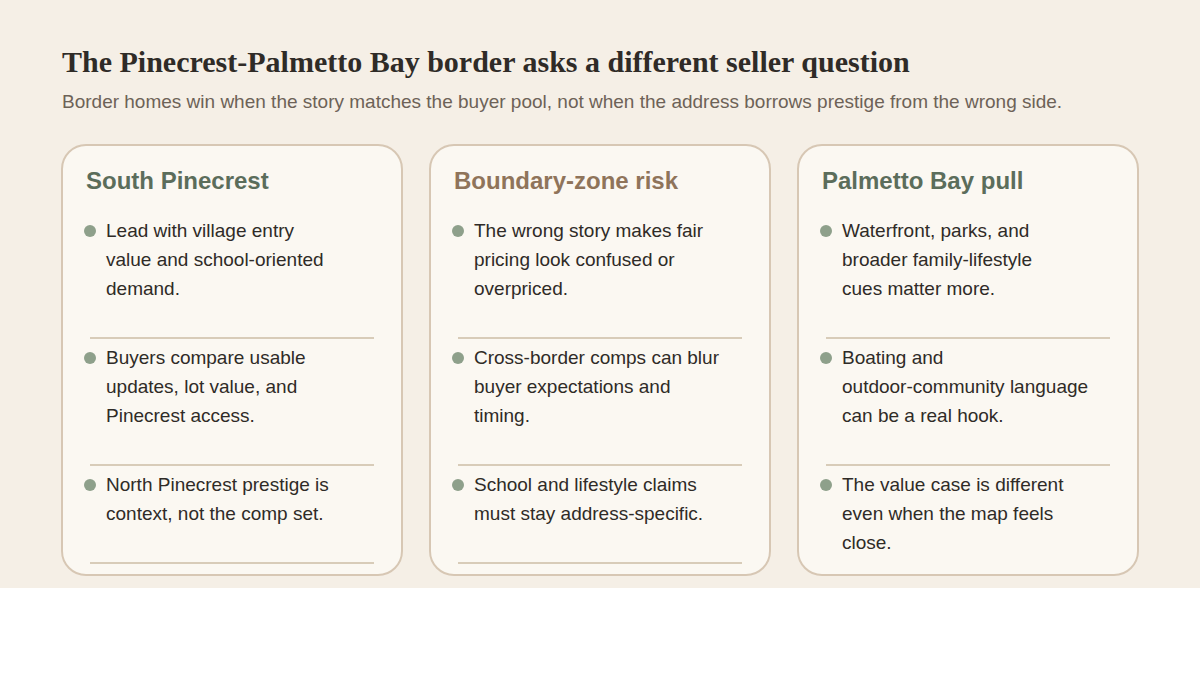 Border homes usually do best when the listing story matches the likely buyer pool instead of borrowing prestige from a nearby label.
Why the Pinecrest-Palmetto Bay line changes the pricing conversation
The seller mistake is not caring about a boundary line too much. It is pretending the line means nothing.
Joanna's Pinecrest overview treats 33156 as several products inside one ZIP, which is exactly why border-zone pricing gets messy in the first place. That Pinecrest label covers estate properties near Gulliver and Pinecrest Gardens, but it also covers South Pinecrest inventory that Joanna explicitly positions as the value entry to village life. On her North vs South Pinecrest pricing guide, she is direct about the issue: streets near the Palmetto Bay edge behave differently from the more prestigious north. I will not republish a village sold average as if it were a South Pinecrest list price.
That does not mean a Pinecrest address stops mattering. It does mean the label alone is not enough. A buyer deciding between a South Pinecrest home and a Palmetto Bay alternative is not reading a map the way a tax appraiser does. That buyer is reading the listing through a lived-life filter:
- Where do the children go during the week?
- Which parks or community routines actually shape weekends?
- Does the home feel like a premium Pinecrest entry point or more like a lifestyle play with outdoor and family convenience?
- Is the seller asking for a North-style halo that the house itself does not support?
This is why cross-border homes deserve a different pricing conversation than a classic North Pinecrest estate. The job is not only to identify comparable sales. It is to identify the buyer imagination you are entering. If the home is trying to compete on the wrong imagination, even a technically defensible list price can feel off.
What Joanna's South Pinecrest guidance says buyers are paying for
Joanna's South Pinecrest page is valuable because it does not oversell the neighborhood. It explains why the section works.
Her language frames South Pinecrest as the place where many families "buy into" the village: the same governance, the same safety reputation, and the same school-oriented identity, but at a more accessible entry point than the large-lot trophy narrative farther north. She also says the neighborhood has more renovation and newer-construction activity than many buyers expect, which is important because it changes what a border-zone seller should emphasize.
In practice, that means South Pinecrest buyers are often paying for four things at once:
-
A Pinecrest address without full estate pricing.
The village still carries prestige, but the buyer does not have to stretch into the North Pinecrest premium band to get it. -
A practical school-and-family story.
The Village of Pinecrest's official schools page lists Pinecrest Elementary, Palmetto Elementary, Howard Drive Elementary, Palmetto Middle, and Miami Palmetto Senior High among the public-school options associated with the village. For sellers, that does not mean every home can promise a specific assignment. It does mean school-oriented households have real village-level context to care about. -
Updated livability.
Joanna says South Pinecrest often attracts buyers who are comparing renovations, modern floor plans, impact openings, kitchens, baths, and hurricane-readiness more carefully than they are comparing social prestige. -
A different pace than North trophy estates.
South Pinecrest can draw a broader qualified pool when the house is priced to this product. That calendar still comes from a CMA. I will not publish a 35-to-42-day South speedometer or a North 48-to-55-day template as market facts.
For a seller near the boundary, the practical lesson is clear: if the house wins because it is a polished, well-updated Pinecrest entry point with solid lot utility and a believable school-oriented value story, the listing should say that plainly. It should not overreach into a broader luxury script that asks the buyer to pretend the home belongs in a different submarket.
Pinecrest amenities still matter in that equation. The Village says Pinecrest Gardens is a 14-acre botanical garden that draws more than 140,000 visitors each year and functions as a cultural and community venue. That kind of civic anchor strengthens the village identity as a whole. But for a South Pinecrest border home, the question is not whether Pinecrest has prestige. It is whether this specific property converts that prestige into the version of value the likely buyer will actually reward.
What Palmetto Bay households usually value instead
Palmetto Bay is close enough to South Pinecrest to steal the wrong comps, but different enough to change the marketing story.
Joanna's homepage and About page describe Palmetto Bay in simple terms: waterfront living and excellent schools, with waterfront sellers benefiting from demand among boating families. That is a different emotional frame from South Pinecrest's "entry to village living" message. One side is often about getting into Pinecrest intelligently. The other side can be about choosing a family-oriented outdoor lifestyle with a different amenity map.
The official Village of Palmetto Bay sources help explain why that framing works. Its school directory lists Coral Reef Elementary, Howard Drive Elementary, Dr. Henry E. Perrine Academy of the Arts, Southwood Middle School, and Miami Palmetto Senior High School, along with multiple private-school links. Its Parks Master Plan describes a municipal system built around Coral Reef Park, Thalatta Estate Park, Palmetto Bay Park, Perrine Wayside Dog Park, Ludovici Park, and future improvements over a ten-year horizon. And the official Coral Reef Park page says that park alone spans more than 50 acres with trails, courts, preserves, playgrounds, picnic areas, and active recreation spaces.
Why does that matter for a seller?
Because buyers do not just compare square footage. They compare the kind of life that seems easiest to build from the front door outward.
If a border-zone home is going to pull attention away from Palmetto Bay alternatives, the listing needs to answer the lifestyle comparison honestly. Does the property win on Pinecrest address and village identity? On updates and interior livability? On lot feel? On a school-oriented move-up case? Or is the real rival a Palmetto Bay home whose pitch is parks, boating adjacency, and a more overt outdoor-family story?
That is the subtle trap for sellers near the line. The home may not need to beat Palmetto Bay on every dimension. It only needs to beat it on the dimension that matters most to the actual buyer.
When a border home should lead with Pinecrest prestige and when it should not
Border-zone pricing goes wrong when sellers assume the best-known local brand should always sit in the headline.
Sometimes that instinct is correct. If the home clearly offers the South Pinecrest value proposition Joanna describes - village identity, school-oriented demand, solid updates, and a stronger everyday address story than nearby alternatives - then the Pinecrest label should lead. It is part of what the buyer is paying for.
Other times, the Pinecrest label is real but not sufficient. A house near the line may be more compelling because of its lot utility, renovation quality, family workflow, or easy competition against nearby Palmetto Bay homes rather than because it evokes the cultural premium of North Pinecrest. In that situation, Pinecrest still matters, but it should be used with discipline rather than with entitlement.
The better test is not, "Can I say Pinecrest?" It is:
- What would make the buyer choose this home over a nearby Palmetto Bay option?
- Would the buyer describe the value in terms of schools and village identity, or in terms of lifestyle and outdoor-community fit?
- Is this home winning because it feels premium for South Pinecrest, or because it feels practical and polished relative to the broader boundary market?
That is why Joanna's micro-neighborhood approach is more useful than generic village marketing. She is not asking sellers to abandon prestige. She is asking them to use the version of prestige the house can actually support.
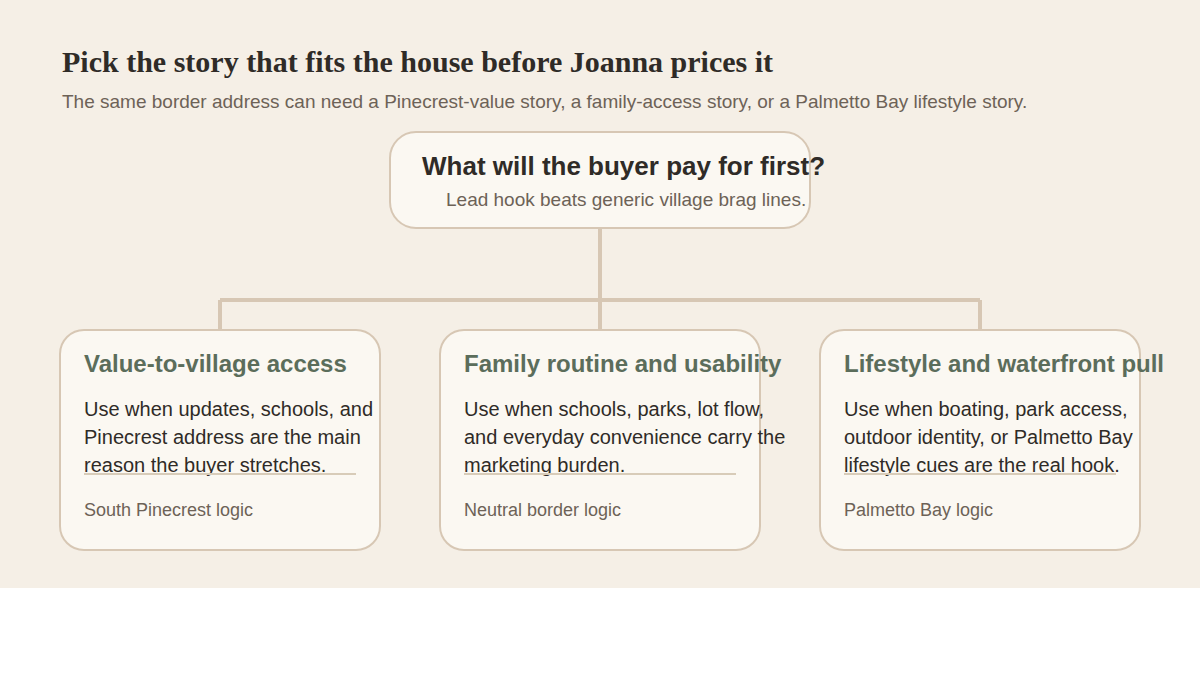 The right lead story usually reveals itself once you ask what the buyer is paying for first, not once you ask which village name sounds stronger.
The comp and positioning mistakes that cost sellers leverage
Most pricing problems near the boundary begin as narrative problems.
The first mistake is using North Pinecrest aura as the hidden benchmark for a South Pinecrest house that is really competing on updates, school logic, and practical village entry. Joanna's own guidance is clear that North and South Pinecrest are different markets. If the seller ignores that and leans too hard on the broad Pinecrest brand, buyers can start treating the ask as aspirational rather than strategic.
The second mistake is swinging too far the other way and borrowing Palmetto Bay lifestyle language without any concrete proof. If the home is not waterfront, not unusually park-connected, and not meaningfully differentiated by that outdoor-community narrative, then a generic lifestyle pitch feels thin. Buyers do not reward a copied story just because it sounds pleasant.
The third mistake is treating school references as village-wide promises instead of address-level facts. The Village of Pinecrest and Village of Palmetto Bay can both point to real school ecosystems, but that still does not make every assignment interchangeable. Border sellers should use official community context and then verify the specific address before turning school language into a headline claim.
Two practical filters help keep the strategy clean:
| Ask before pricing | Why it matters |
|---|---|
| Which nearby alternatives will a serious buyer actually tour? | This keeps the comp set tied to real substitution behavior rather than to civic pride. |
| What is the first value story the photos support? | It keeps the headline, media, and list price aligned instead of sending mixed signals. |
| Which local facts need address-level verification? | It prevents school or micro-location language from drifting into casual overstatement. |
When these filters are missing, the listing often ends up paying twice: once in weak initial response and again in the form of price-defense fatigue later.
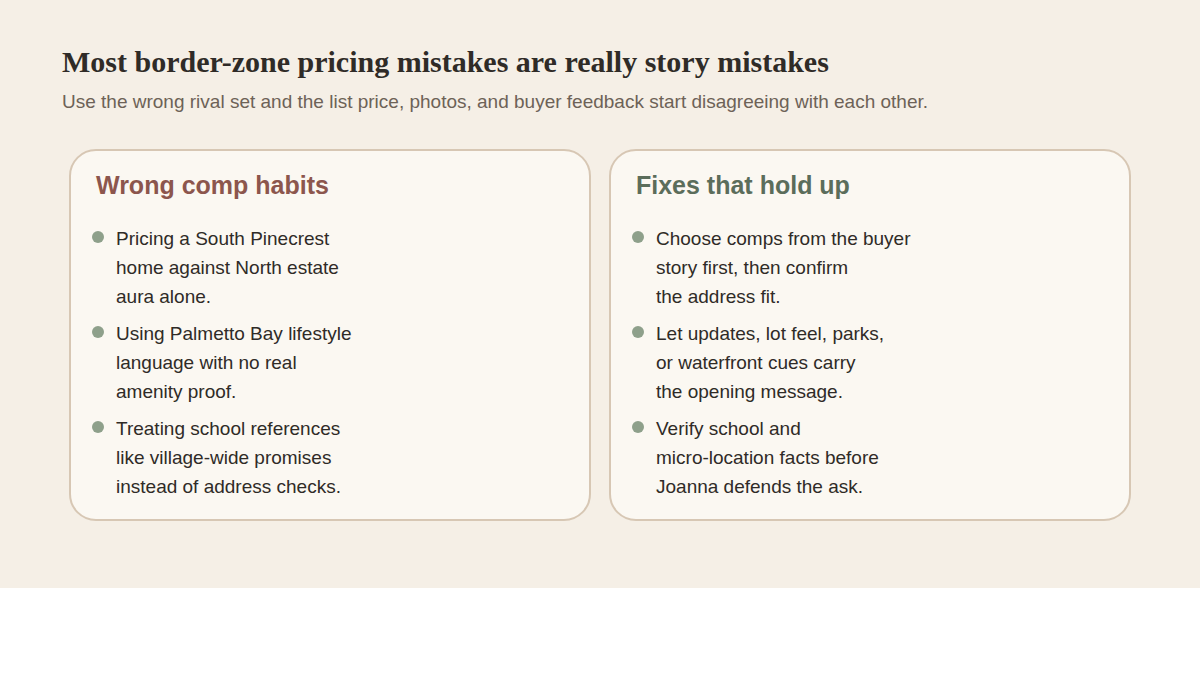 The cleanest border-zone pricing usually comes from matching the comp set to the buyer story first and the village label second.
How to brief Joanna before launch
If I were preparing a home near this line for market, I would want Joanna to answer six questions before we talked about a launch date:
-
Which buyer pool is most realistic for this address right now?
Village-entry family buyer, updated move-up household, outdoor-lifestyle buyer, or some hybrid? -
Which nearby alternatives will buyers compare first?
Not theoretically. In real search behavior. -
What is the lead advantage?
Pinecrest identity, renovation quality, lot usability, school context, park and community rhythm, or something else? -
Which comps deserve the most weight, and which ones are only noise?
This is especially important when the seller is tempted to justify the ask with prettier but less relevant sales. -
Which property details need verification before they become marketing language?
School assignment, frontage nuances, flood or insurance questions, waterfront descriptors, and any amenity claim that sounds stronger than the documentation behind it. -
What prep work will make the pricing story easier to believe?
In South Pinecrest that might be kitchen, bath, impact, or landscaping clarity. In a more Palmetto Bay-leaning comparison set, it might be outdoor lifestyle cues, family-function improvements, or amenity connection.
That kind of briefing keeps the pricing conversation honest. It also protects sellers from the common border-market trap of defending a number that the listing itself does not fully explain.
If your home sits near the Pinecrest-Palmetto Bay line, the smartest first step is not asking which village name sounds stronger. It is asking which story your buyer will believe fastest. Joanna's seller strategy works best when that answer shapes the comp set, the prep budget, the photography plan, and the headline from day one. You can start that conversation through Joanna's Pinecrest seller resources or by reaching her directly at (305) 302-6384 for a property-specific valuation.
This article is educational and is not legal, tax, appraisal, or school-assignment advice. Buyer behavior, school assignments, and pricing outcomes vary by address, condition, timing, and current inventory, so confirm the details for your property with the appropriate professionals before relying on this guidance.
Selling in ?
Get a free valuation or explore seller services in your area.