Selling Near Baptist Hospital in Kendall: What 33176 Buyers Actually Pay For
If you are thinking about selling near Baptist Hospital in Kendall 33176, the easiest mistake is also the most common: assuming the hospital name does all the work for you.
It does not.
In the Baptist Area, the same house can attract a nurse who wants a shorter weekday, a young family that cares more about quiet and school logistics than the hospital itself, and an investor who is underwriting remaining useful life rather than admiring your staging. Joanna's Baptist Area seller page makes that tension clear. The commute story matters when it is true on the map, but the neighborhood still has block-by-block differences in traffic, noise, flood questions, and buyer psychology.
The official Baptist Health Education Center page also helps frame why this pocket gets attention at all. It places the Baptist campus at 8900 North Kendall Drive and notes nearby transit access and regional connectivity. That supports the broader location story. It does not mean every nearby listing should be marketed as if it sits on a perfect quiet street with hospital-adjacent convenience and no tradeoffs.
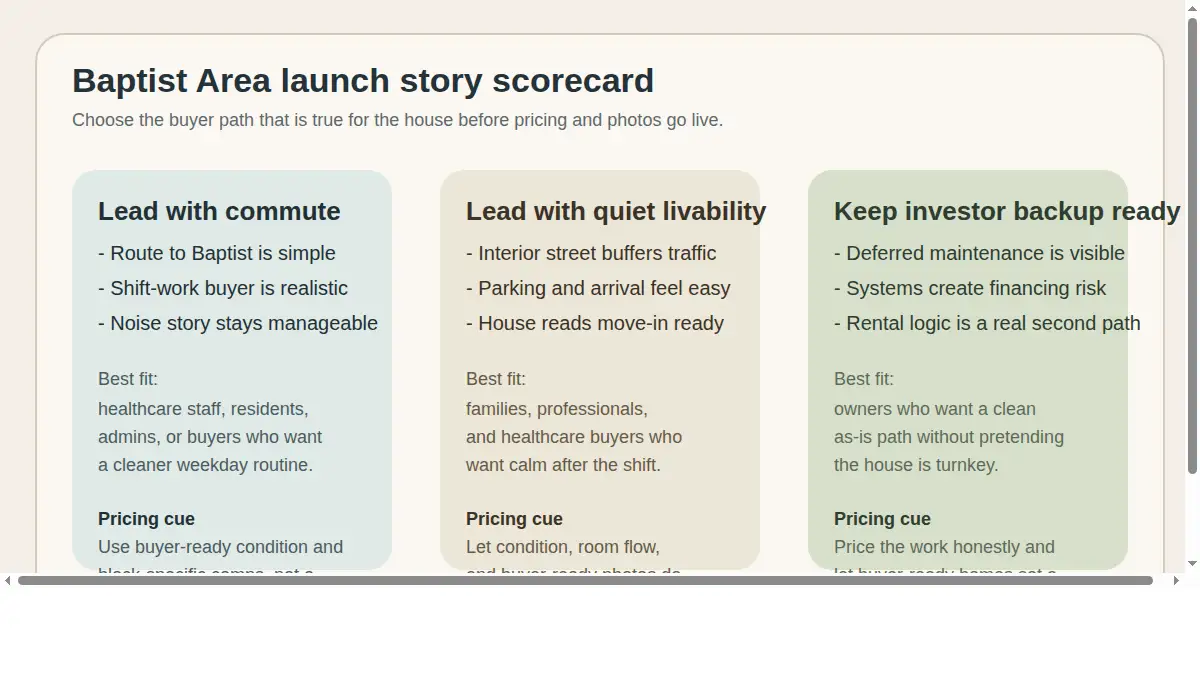
When I advise sellers here, I would rather make one clean decision early: are we launching this home around healthcare convenience, around calmer day-to-day livability, or around an honest as-is or investor backup path? Once that decision is clear, pricing, photography, and showing language usually become much easier.
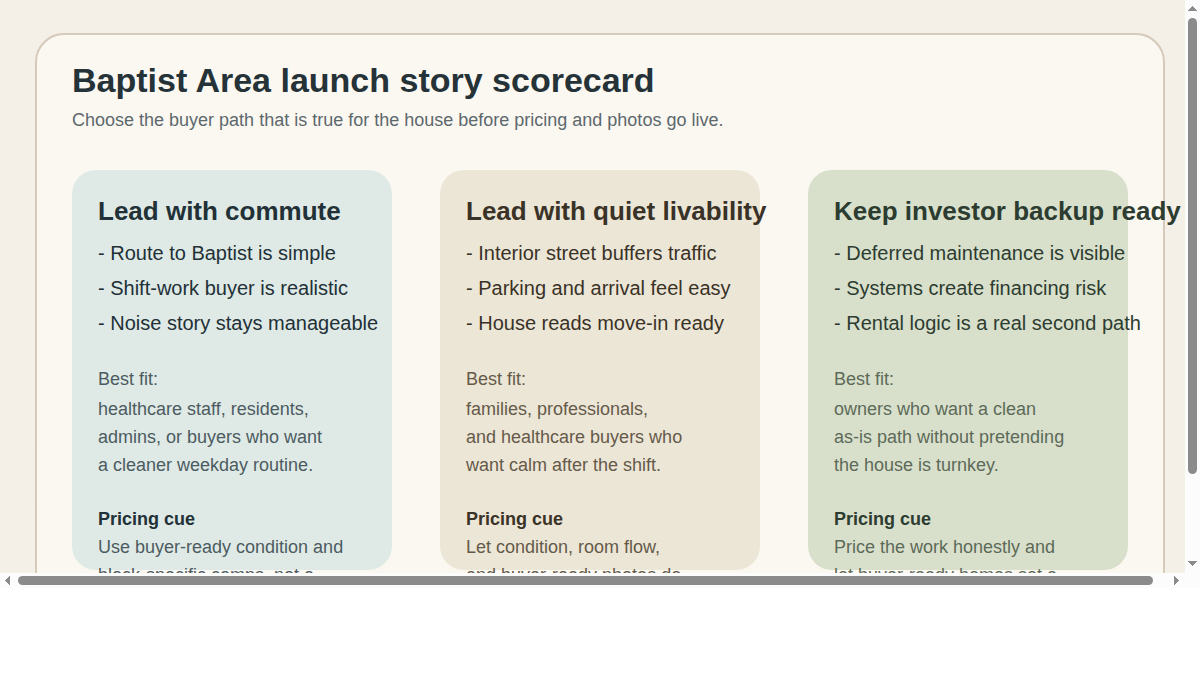 The Baptist Area usually performs best when the listing story clearly chooses the buyer path it is trying to win first, instead of mixing hospital, family, and investor language all at once.
Why the Baptist Area is a buyer-path problem, not a ZIP average
One reason sellers misread this pocket is that 33176 looks respectable in broad data, so it becomes tempting to turn ZIP context into a pricing shortcut.
Census Reporter’s 2024 profile for 33176 shows a median household income of $86,354, a mean commute time of 30.1 minutes, a median owner-occupied value of $638,900, and 43.7% of adults with a bachelor’s degree or higher. Those figures tell you the ZIP has established households, professional buyers, and real housing value. They do not tell you what your particular block near Baptist should ask, how your tour traffic will split, or whether your home is better positioned for a commuting household or an investor.
That is why Joanna’s 33176 neighborhood guide keeps coming back to the same point: Kendall is several micro-markets inside one ZIP code. Baptist Area homes are not Snapper Creek. They are not Continental Park. They are not Killian. And they are certainly not Pinecrest just because the drive north feels short.
In practical terms, that means the Baptist Area behaves less like a prestige label and more like a positioning choice. A house on a quieter interior street may appeal to healthcare professionals precisely because it softens the workweek. Another house closer to the campus may win because the buyer values pure convenience over every other concern. A more dated house may still sell well, but the strongest audience may be the investor or medical-rental buyer who is pricing the work honestly.
I think that framing helps sellers avoid two expensive habits:
- pricing the neighborhood as if hospital proximity automatically creates a premium, and
- hiding tradeoffs buyers are going to notice anyway.
The smarter approach is to decide which advantage is actually true for the property in front of you, then build the listing around that advantage instead of around the neighborhood name alone.
When Baptist commute proximity should lead the listing story
There are absolutely homes in this pocket where commute convenience deserves to be near the top of the marketing story.
If the property genuinely offers a shorter weekday to Baptist, easier access to Kendall Drive, straightforward in-and-out movement for shift schedules, or practical proximity to Dadeland amenities, that is useful. Joanna’s Baptist Area pages say as much, and the Baptist Health campus materials reinforce that the hospital is a real regional anchor rather than a vague landmark.
But "near Baptist" only works as a headline when the convenience is believable.
That means I would want to answer a few questions before leaning on it:
- Is the route actually simple, or does the home sound closer than it feels?
- Does the property benefit from nearby transit or bus access in a way a buyer could really use?
- Is the commute story cleaner than the noise or traffic story?
- Does the likely buyer pool include people whose weekday schedule makes this a real quality-of-life improvement?
The transit context is a good example of why precision matters. Baptist Health says the campus is minutes from Dadeland South Metrorail, while Miami-Dade’s Better Bus routes page lists Route 88 and Route 104/104A as serving Baptist Hospital on runs tied to Dadeland North. That is useful public context. It also tells you not to write lazy copy like "direct Metrorail access" unless you have verified what that means for the specific address and the specific buyer.
The other reason to be disciplined here is that convenience alone does not rescue a house that still feels like work. NAR’s 2025 coverage of the Remodeling Impact Report notes that 46% of buyers are less willing to compromise on home condition. In a Baptist Area context, that means the healthcare buyer who wants a shorter weekday may still walk away from the right location if the roof, flooring, paint, or systems create too much uncertainty on day one.
So yes, lead with the hospital when it is a real advantage. Just make sure the house supports the promise.
When quiet, parking, and move-in condition matter more than the hospital name
Some of the best Baptist Area listings are not the ones that shout the loudest about the campus. They are the ones that understand what a hospital-adjacent buyer actually wants after the shift ends.
That buyer may still value calm more than sheer proximity.
If the home sits on an interior street, buffers noise well, has an easier parking and arrival sequence, or simply feels more settled than another option closer to the campus, I would usually market those points harder than a generic "minutes to Baptist" line. Joanna’s live area pages make this distinction directly: campus noise and traffic are real, and nearby interior streets can sell a very different weekday experience.
This is also where move-in condition starts pulling serious weight. A healthcare professional, administrator, or dual-income family may like the location, but they often do not want to inherit a full project after closing. National staging data supports that instinct. In NAR’s 2025 staging report coverage, 83% of buyers’ agents said staging helped buyers visualize the property as their future home, and the priority rooms they call out are the living room, primary bedroom, kitchen, dining room, and outdoor spaces.
That matters in the Baptist Area because the winning story is often not "hospital worker wants anything nearby." It is "busy buyer wants a home that feels easy." Quiet bedrooms, updated baths, good light, an orderly kitchen, clean parking, and a calm first five minutes can outweigh a slightly shorter drive.
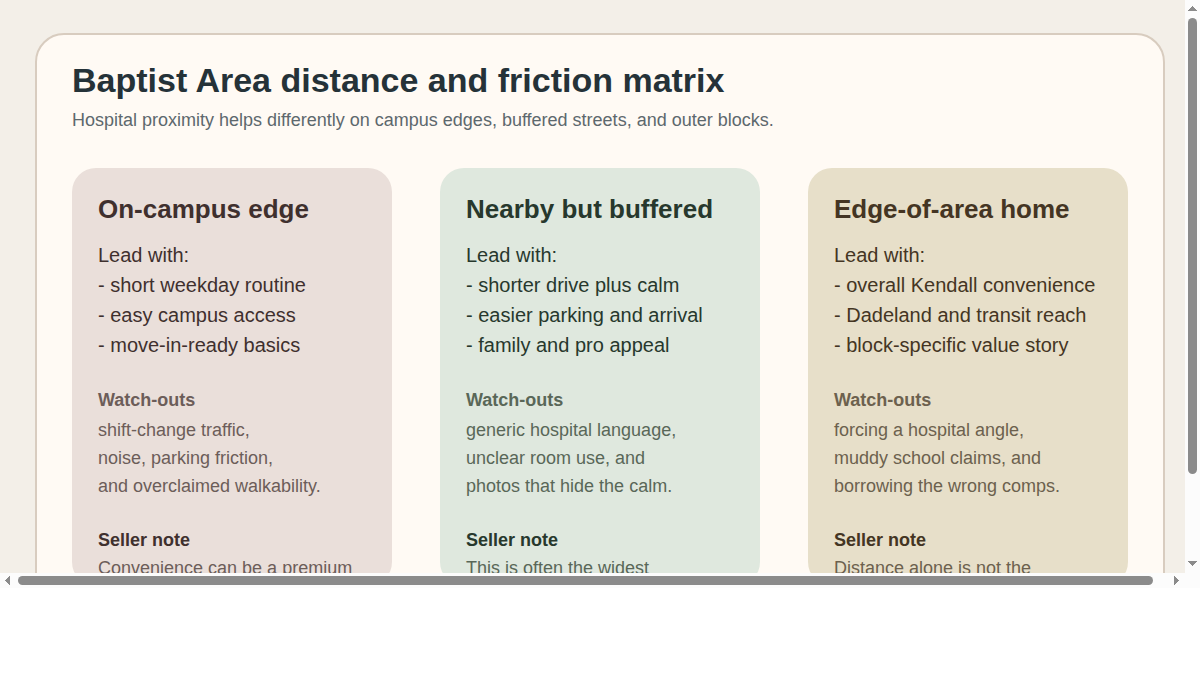 In this pocket, a home can benefit from Baptist proximity without needing to market itself as if every buyer wants to hear an on-campus story.
If your home wins on interior livability, then say so with confidence. I would rather show a buyer why the house feels manageable on a Tuesday than force a hospital angle that is only half true. In many cases, that creates a broader pool: healthcare buyers still understand the location, while families and professionals who value Dadeland access, retail convenience, and a calmer street do not feel like the listing was written for someone else.
How to choose between healthcare-buyer pricing and investor backup
One of the strongest things about this pocket is that it can support more than one buyer path. One of the most dangerous things about this pocket is that sellers sometimes use that fact as an excuse to stay vague.
I would not.
Joanna’s broader Kendall seller guidance is clear that investors and owner-occupants do not evaluate the same house the same way. The Baptist Area seller page says investors are a real second path. That is useful. It does not mean investor demand should become the default excuse for a padded list price or unfinished prep.
Here is the cleaner decision tree:
If the home is broadly livable and only needs selective cosmetic help, I usually prefer to aim first at owner-occupant or healthcare-professional buyers. NAR’s remodeling guidance is helpful here because the top agent-recommended pre-sale projects are simple ones: whole-home paint, a single-room paint refresh, and a new roof when needed. That lines up with what I see in Kendall. Broad-appeal fixes tend to do more for showing quality than an expensive, personalized renovation.
If the home has meaningful condition drag, investor backup becomes more relevant. That can mean major system age, obvious deferred maintenance, layout compromises, or a house whose best buyer is the person willing to underwrite the work instead of emotionally overlook it. In that case, price and photos should acknowledge the reality instead of staging the property as though a family buyer will happily pay turnkey numbers.
If the home can attract both paths, the right answer is not muddled messaging. The right answer is disciplined positioning. That might mean the photos and first listing language still prioritize livability, while the pricing stays close enough to reality that investors also engage. Or it may mean the reverse: clear as-is language with enough documentation that a confident owner-occupant can still step in.
What I would avoid is the middle ground that pleases nobody:
- heavy staging on a house still priced like a project,
- investor language on a fully updated home that should invite financed buyers to compete,
- or hospital-premium copy on a property where the real issue is condition, not location.
In other words, investor demand is a useful safety net. It is usually a poor substitute for choosing a real lead story.
The prep list that changes who shows up first
Before photos and pricing go live, I would want a Baptist Area seller to clear a short list that reduces guesswork for buyers.
Start with map truth. If the listing is going to talk about proximity to Baptist, Dadeland, or transit, check the exact route first. Do not rely on a neighborhood label. Use the real block, the real drive, and the real transit context.
Then move to school truth. Joanna repeatedly warns that school assignment is address-specific. Miami-Dade’s Community Services search tool exists for exactly that reason: enter the address, review the school attendance information, and avoid turning an assumption into a headline.
Next comes condition truth. Ask what a buyer will notice in the first ten feet, then what an inspector or appraiser will notice next. In this pocket, paint, visible maintenance, roof confidence, lighting, flooring, and exterior order all change who feels comfortable writing an offer. If your likely buyer is a healthcare professional or family, these are not cosmetic side notes. They are trust signals.
After that, assemble paperwork truth. Flood context, insurance questions, parking quirks, transit claims, and any meaningful repairs should be explainable without improvising during showings. A calm answer is part of the product.
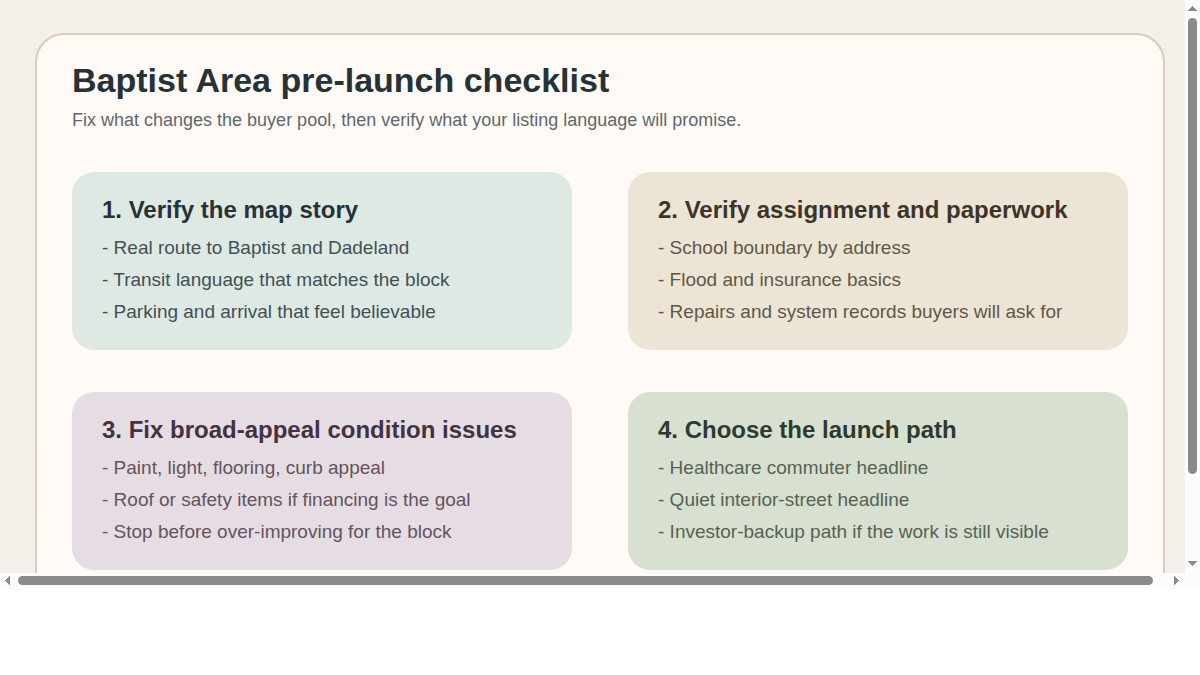 The strongest Baptist Area launches prove commute, condition, and paperwork early so buyers spend less energy guessing and more energy competing.
Finally, decide on presentation truth. If the home is targeting owner-occupants, the listing should make it easy for them to imagine life there. That usually means better editing, cleaner rooms, stronger arrival photos, and a more disciplined story about how the house actually lives. If the home is targeting investors, spend less energy on lifestyle theater and more on honest condition, remaining useful life, and the reasons this block still matters.
The common thread is simple: the faster buyers understand the house, the more seriously they tend to treat the price.
What Joanna should verify before launch
Before I would bring a Baptist Area listing live, I would want six questions answered clearly:
-
Which buyer path is most realistic for this house first?
Healthcare commuter, family and professional owner-occupant, investor, or a deliberate blend? -
What is the cleanest location story?
True hospital convenience, quieter buffered street, Dadeland access, or some combination that can be defended honestly? -
What condition issue changes the buyer pool fastest?
Roof, paint, flooring, systems, curb appeal, or simply clutter and unclear room use? -
Which claims need address-level verification before they go public?
School assignment, flood questions, transit references, walkability, and drive-time language all belong here. -
Does the list price match the buyer path?
Financed healthcare and family buyers need a price an appraisal can survive. Investors need a number that respects the work. Those are not the same worksheet. -
What should the showing conversation sound like?
If the first buyer question will be about noise, traffic, schools, or insurance, I want that answer ready before the first showing, not after the first low offer.
That is usually where the best Baptist Area strategy lives. Not in a generic Kendall average. Not in a one-size-fits-all commute pitch. And not in the assumption that being near a major hospital automatically fixes price, condition, and buyer fit.
If you want to sell well in this part of 33176, start with a property-specific strategy session. Joanna’s Baptist Area seller page and broader Kendall 33176 guide are useful starting points, but the real leverage comes from matching the house, the block, and the buyer path before the listing ever goes live.
This article is educational real-estate commentary, not appraisal, legal, lending, school-assignment, insurance, or flood advice. Buyer response, traffic, school boundaries, transit use, and value vary by address and market conditions, so confirm the details that matter for your property before relying on this guidance in a sale.
Selling in Kendall?
Get a free valuation or explore seller services for ZIP 33176.