Remote-First Executives Choosing Pinecrest: What Sellers Should Highlight
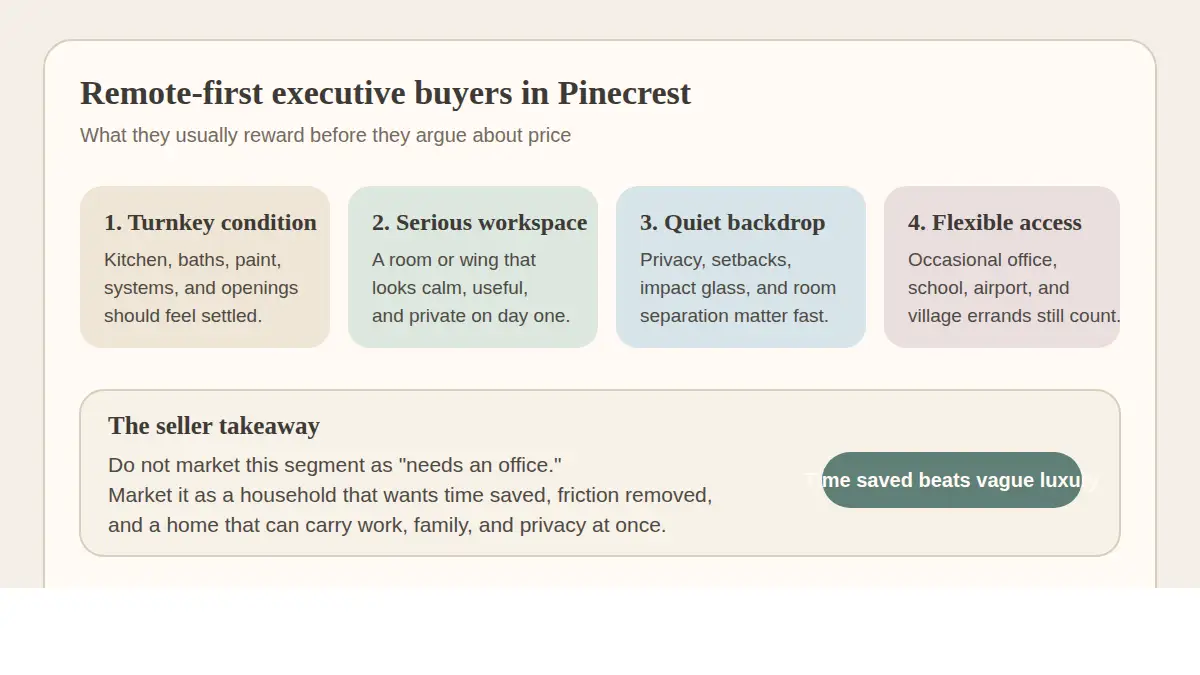
For remote-first executives choosing Pinecrest, the mistake many sellers make is assuming that less commuting means less selectivity. In Pinecrest, I usually see the opposite. A remote-first executive household may not need to drive into an office five days a week, but that often makes the home itself more important, not less. The property has to work as a daily headquarters, a family backdrop, a private retreat, and a place that still feels connected when in-person meetings, school routines, airport runs, or hospital visits suddenly matter.
That is why a generic "great for working from home" line rarely helps. A serious buyer in this segment wants a cleaner answer: does the house feel composed, quiet, turnkey, and specific to the kind of life they actually run?
Census Reporter’s 2024 profile for ZIP 33156 gives useful background for why this conversation is real in Pinecrest. It shows 21.3% of workers in 33156 working from home, a $137,076 median household income, and 65.7% of adults with a bachelor’s degree or higher. Those ZIP figures are not a buyer census, and they do not tell you what your home is worth. They do show why a professional, high-information household is not some fringe Pinecrest audience.
Joanna’s own Pinecrest buyer guide points in the same direction. Her live positioning describes relocating professionals and executives as a real part of the Pinecrest mix, and she separates Pinecrest micro-neighborhoods by the exact tradeoff many of these households care about: convenience in the east, estate privacy in the north, and seclusion in the west.
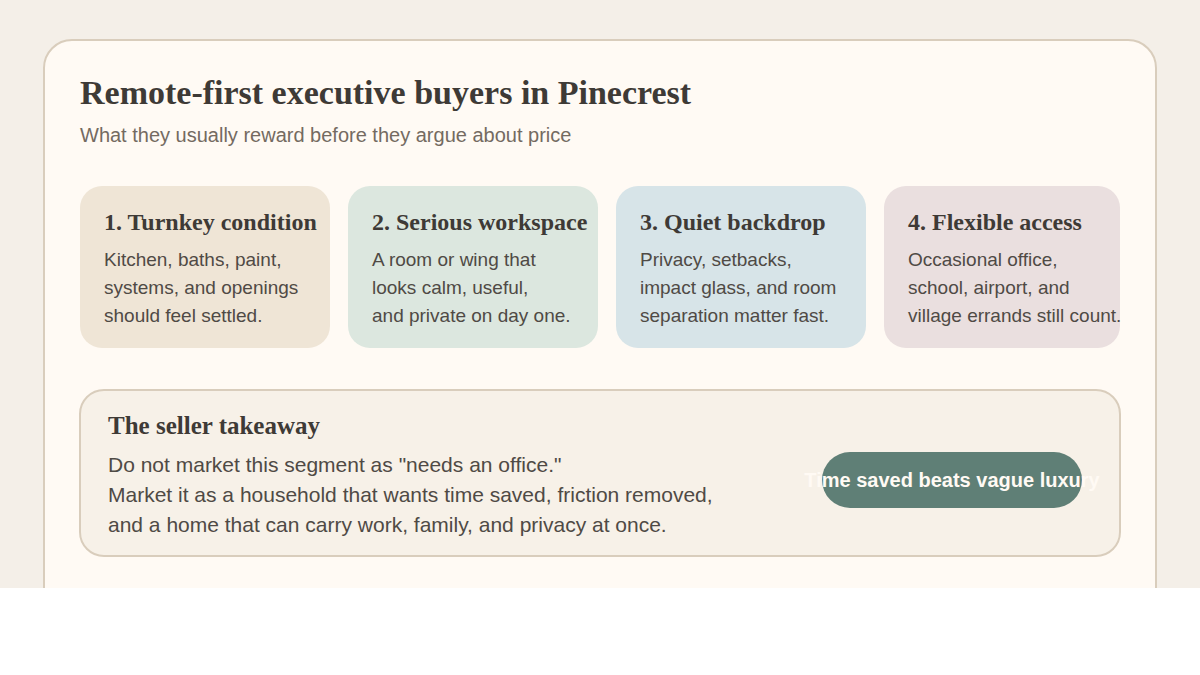 For remote-first executive buyers, the home has to feel like a complete operating environment, not just a pretty address with a spare bedroom.
Why remote-first executives still fit Pinecrest's buyer mix
Remote-first does not mean anti-location. It means location gets judged differently.
In Joanna’s broader Pinecrest overview, the village still wins on the same things that have always pulled serious buyers into 33156: schools, lot size, privacy, village identity, and limited inventory. What changes for a remote-first executive is the weighting.
This buyer is often less impressed by a vague "easy commute" promise than by whether the home solves weekday life elegantly. They may go to Brickell twice a week instead of five times. They may fly often. They may manage teams on Zoom from home three days straight, then spend one day in an office and another at a client lunch. That routine makes a house feel either frictionless or quietly exhausting.
The 33156 context matters here. A ZIP where more than one in five workers are already working from home, where educational attainment runs high, and where household income sits well above metro and state figures is exactly the kind of environment where sellers should assume buyers will notice operational details. Office flexibility, acoustic calm, privacy, room sequencing, lighting, and the feel of the outdoor spaces are not side notes when the home is part of the workday.
Joanna’s buyer guide is also helpful because it keeps this from turning into a trendy remote-work article. Her framework says Pinecrest buyers still prioritize school situation, move-in-ready condition, outdoor living, privacy and lot size, and modern technology and safety. That is a much better seller lens than pretending remote buyers are only searching for an office with a pool.
In other words, the remote-first executive household still buys Pinecrest for village reasons. They just notice the home’s day-to-day usability faster than a seller who is marketing only to school-driven family buyers might expect.
What these buyers pay for before they ask about commute days
The cleanest way to market to this segment is to stop thinking in terms of one feature and start thinking in terms of one friction level.
When Joanna describes relocating professionals in Pinecrest, she does not say they are looking for a project. Her buyer guide puts their decision factors in a practical order: overall quality, location, turnkey condition, and then price. Her seller pages make the same point operationally through staging, premium photography, showing control, and prep sequencing before launch.
For a remote-first executive household, the most valuable features usually fall into five buckets:
-
A home that feels finished, not negotiable.
Remote-first buyers are often time-poor. They may have capital, but they do not want to inherit months of contractors, permitting, and room-by-room disruption right after closing. Kitchens, baths, flooring condition, paint, openings, lighting, and systems confidence matter because they protect time as much as they protect aesthetics. -
At least one room that reads as serious workspace without apology.
This does not require a labeled "office" in the tax roll. It does require a room, built-in niche, library, den, or wing that can plausibly support concentration, video calls, and privacy without feeling like a leftover guest bedroom. -
Quiet and visual order.
The work-from-home household notices acoustic clutter differently. Impact windows, mature landscaping, deeper setbacks, sensible room separation, and a calm backdrop for calls often read more strongly than one extra decorative room. If the home is near a busier edge, the listing should compensate with stronger proof of interior calm rather than pretending the issue is irrelevant. -
Outdoor space that extends the workday gracefully.
Joanna’s Pinecrest positioning has long emphasized privacy, pool condition, and outdoor living. For the executive buyer, outdoor value is not just entertaining. It is decompression, phone-call privacy, an easy coffee break, and a house that feels restorative between obligations. -
Technology and safety that feel expected, not improvised.
Joanna’s buyer guide explicitly calls out impact windows, security, smart-home capabilities, and electrical readiness as part of what Pinecrest buyers increasingly expect. That does not mean you invent features. It means you should market the real ones cleanly when they exist.
The key is that these buyers are usually paying for time saved and friction removed. A spare room alone does not create that feeling. A coherent, polished, operationally calm house does.
Which Pinecrest micro-neighborhood story to lead with
One reason generic remote-work copy falls flat is that not every part of Pinecrest solves the same problem.
Joanna’s About and Pinecrest pages already provide the structure sellers need:
| Micro-neighborhood story | What to emphasize for executive buyers | What to avoid |
|---|---|---|
| East Pinecrest | Convenience with village living, cleaner access to US-1 amenities, and proximity to Metrorail connections when occasional in-person travel matters | Overselling walkability or transit ease without checking the exact address and route |
| North Pinecrest | Estate character, Gulliver and Pinecrest Gardens context, larger lots, privacy, and prestige that support a composed work-from-home environment | Marketing only on prestige while ignoring whether interiors and systems feel current enough for a selective buyer |
| West Pinecrest | Seclusion, larger private envelopes, mature landscaping, and the sense of a retreat for buyers who care more about calm than convenience | Treating privacy as enough on its own if the house still feels dated, dim, or operationally awkward |
| South Pinecrest | Entry to village living, renovation quality, hurricane readiness, and value relative to higher-priced Pinecrest pockets | Borrowing north-estate language when the real appeal is polished function and smart buy-in |
That table matters because executive buyers are not one monolith either.
Some households really are buying convenience with prestige. They want Pinecrest, but they also want cleaner weekday flexibility when the office, airport, or South Miami corridor becomes part of life again. For them, East Pinecrest can be a better story than a more private but less connected location.
Others are buying controlled privacy first. They may be on calls all day, host people selectively, or simply want the house to feel removed from noise and pace. For those buyers, North or West Pinecrest can be more compelling than a convenience pitch.
And some are still buying the smart Pinecrest entry: a home with solid updates, a credible office setup, real storm-readiness, and enough village identity to beat other Miami options without demanding a trophy-estate budget. That is usually a South Pinecrest or renovation-quality conversation, not a generic luxury script.
The seller mistake is using whichever Pinecrest adjective sounds strongest instead of whichever one matches the parcel and the buyer. A remote-first executive will usually pick up on that mismatch quickly. If the location story says "effortless convenience" but the access feels less graceful than implied, trust drops. If the listing says "private estate living" but the office nook sits off the loudest part of the house, the prestige story weakens.
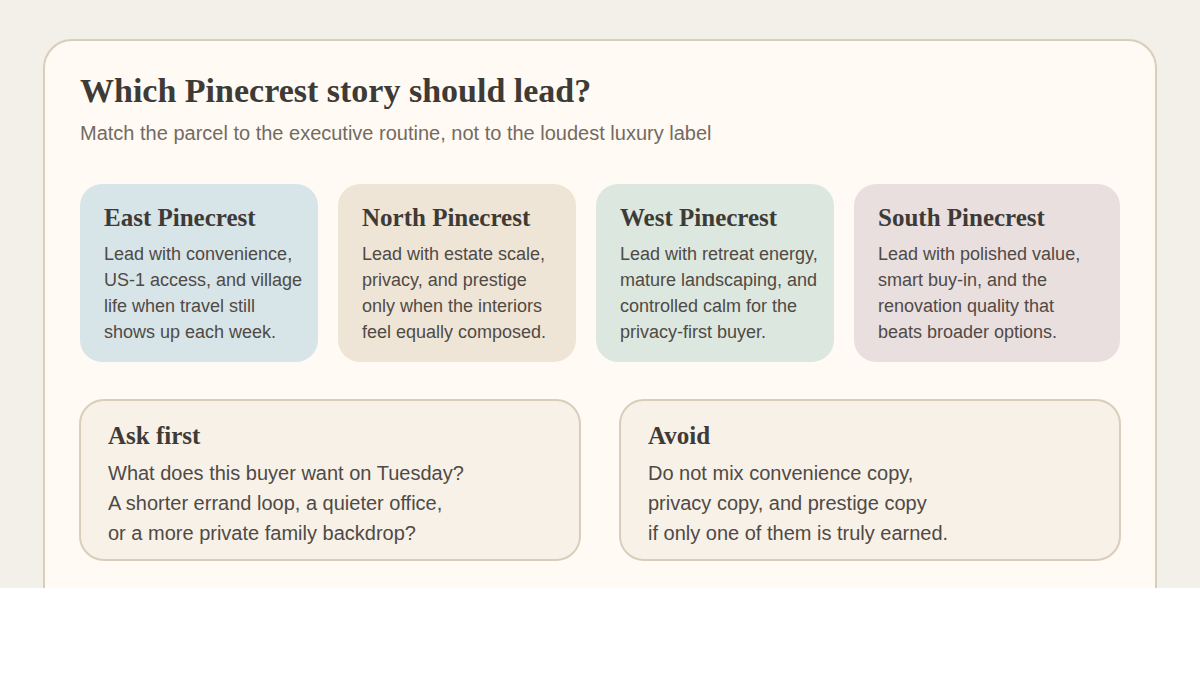 The strongest launch story is usually the one that matches how the buyer plans to live on Tuesday, not just what sounds luxurious on Saturday.
The prep details that make a home feel turnkey for hybrid life
If I were advising a Pinecrest seller whose likely buyer is an executive household, I would want the launch plan to answer four practical questions before the photos are taken.
1. Where does focused work happen?
Show the answer visually. Do not leave it to imagination if you can help it.
A room with a desk, proper scale, natural light control, and a calm background usually photographs better than an empty flex room marketed with copy alone. If the best workspace is a library, loft, sitting room, or bedroom five, stage it with conviction. The buyer should understand the function in one glance.
2. What makes the house feel quiet and low-friction?
You do not need to oversell silence. You do need to identify the real confidence points. Impact windows, deeper setbacks, mature hedges, insulated room separation, updated systems, organized storage, and a smooth arrival sequence all contribute to the feeling that a professional can run a demanding week from this house without fighting it.
This is where Joanna’s Pinecrest seller page is useful. Her process already assumes staging, premium photography, and preparation are part of value creation. For this segment, that preparation should not stop at visual polish. It should also clarify how the home functions.
3. What does the buyer do between meetings?
That question may sound soft, but it is often where Pinecrest earns its premium. Joanna’s buyer guide stresses outdoor living, privacy, and mature landscaping for a reason. A remote-first executive buyer may spend more waking hours on the property than a household that leaves at 7 a.m. and returns at 7 p.m. The pool, covered terrace, side garden, breakfast area, and private corners therefore carry more weight than a seller might think.
4. Which upgrades save the buyer time on day one?
This is where sellers should think less about "luxury" in the abstract and more about unfinished decisions. If the electrical panel is modern, the security system is current, the lighting feels intentional, the paint is neutral, and the openings are handled, say so cleanly. If those things are unresolved, the buyer does not see an abstract future budget. They see calendar drag.
The right prep plan is not necessarily expensive. It is selective. Sometimes it means painting, decluttering, and staging the best office room properly. Sometimes it means tightening landscaping so privacy reads as elegant instead of overgrown. Sometimes it means documenting the systems and features that keep a demanding household from feeling like it just bought another project.
The seller mistakes that turn convenience into generic copy
The first mistake is reducing the whole segment to "home office buyers."
That is too thin for Pinecrest. A remote-first executive household may care about office function, but it is still buying into schools, privacy, safety, outdoor living, and village identity. If the listing sounds like it belongs in any suburban market with fiber internet, it is probably missing what makes Pinecrest specific.
The second mistake is overclaiming convenience.
Joanna’s About page is careful: East Pinecrest appeals to professionals prioritizing convenience with village living. That is a positioning guide, not a promise that every address feels equally walkable, equally quiet, or equally easy for every routine. Sellers should resist vague lines about Metrorail, US-1 access, or "minutes to everything" unless the real-world route is part of the property’s honest story.
The third mistake is letting privacy feel accidental instead of intentional.
For this buyer, privacy is not just about a gate or hedges. It is about whether the home feels controlled. Are sightlines thoughtful? Does the office setup avoid the busiest circulation path? Do the exterior photos show calm rather than clutter? Does the house look like it can support work, family, and guests without one function disrupting the others?
The fourth mistake is pricing a turnkey-time-saver like a maybe-project.
Remote-first executive buyers can be flexible on some lifestyle details, but they are often impatient with ambiguity. A house that truly solves daily life can justify a stronger story. A house that still needs too many decisions should not be priced as though the buyer is inheriting none of that work.
The fifth mistake is assuming commute no longer matters because remote work exists.
The ACS 33156 figure shows meaningful work-from-home presence, not the death of in-person life. People still travel, still attend meetings, still visit campuses, still deal with school logistics, and still value time. Remote-first buyers usually want the option to be out in the world when needed without feeling punished by the house they chose.
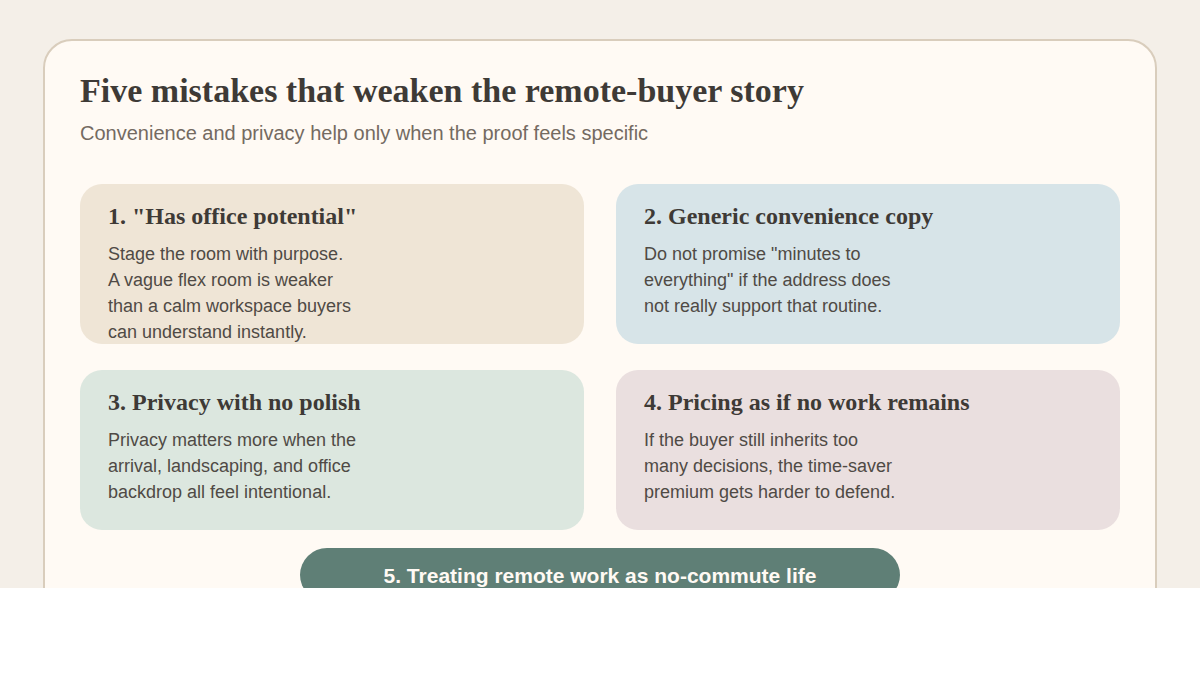 The strongest listing does not yell "remote work." It quietly proves that the house can support demanding work and family rhythms without unnecessary friction.
How to brief Joanna before launch
Before I would market a Pinecrest home to this buyer segment, I would want six questions answered clearly:
-
Which executive household is most realistic for this property?
East-side convenience buyer, privacy-first estate buyer, relocating family with hybrid schedules, or some combination? -
What is the clearest daily-life proof point?
Dedicated office, calm arrival, private outdoor space, impact openings, smarter systems, or school-and-location convenience? -
Which micro-neighborhood story is true enough to lead with?
Convenience, privacy, prestige, or value-with-function? -
What prep item would most improve buyer confidence before photos?
Staging the workspace, simplifying a noisy room, refreshing landscaping, documenting systems, or tightening a dated area that makes the whole home feel less turnkey? -
Which convenience claims need verification by address?
Route claims, school framing, transit references, and amenity proximity all need to be accurate. -
Does the list price reflect the buyer’s likely tradeoff?
If the home is a real time-saver, price can defend that. If the buyer is still inheriting unresolved work, the ask should respect it.
That is the conversation I would rather have than debating whether every work-from-home buyer just wants "an office." In Pinecrest, the remote-first executive segment is more nuanced than that. These buyers still want the same village advantages other serious buyers want. They simply notice operational quality, privacy, and daily friction with unusual speed.
If you think your likely buyer is a professional or executive household, start with a positioning conversation rather than generic luxury copy. Joanna’s Pinecrest seller page is a good starting point, but the real value comes from matching the micro-neighborhood, the prep plan, and the list price to the buyer your home can actually win.
This article is educational real-estate commentary, not legal, tax, appraisal, school-assignment, or commute advice. Buyer behavior, work patterns, school priorities, and location tradeoffs vary by household and address, so confirm the details that matter for your property before relying on this guidance in a sale.
Selling in Pinecrest?
Get a free valuation or explore seller services for ZIP 33156.