Pinecrest New Construction vs Renovated Estate: Seller Guide
Pinecrest New Construction vs Renovated Estate: Seller Guide
This Pinecrest new construction vs renovated guide starts with a blunt reality: buyers in Pinecrest are benchmarking almost every listing against something newer, cleaner, or easier. When I look at how a home should launch today, I do not start with square footage alone. I start with the question buyers are already asking in their heads: Is this a turnkey alternative to new construction, a land-value play, or a house that still needs too many answers?
That distinction matters more in a market where Joanna's Q2 2026 Pinecrest update describes buyers as selective about value, condition, and pricing, while still rewarding land, privacy, usable layout, and correct preparation. It also matters because Joanna's own best time to sell in Pinecrest guide treats July and August as the slowest part of the year. If a seller launches into a softer window with the wrong story, the market usually punishes the mismatch quickly.
 The first job is choosing the right lane: turnkey renovation, land-value opportunity, or a compromise listing that still needs sharper pricing and cleaner proof.
Why this comparison matters in Pinecrest right now
Pinecrest is not a market where an older estate automatically wins because the address is prestigious. Joanna's seller guidance for Pinecrest says current buyers are informed, analytical, and comparing homes across Pinecrest and nearby options instead of buying on urgency alone. Her Q2 2026 market update also frames today's environment as one with more active inventory and more choices, even though the overall value backdrop remains strong.
That combination changes how older homes are judged. A 1970s or 1980s house on a beautiful lot may still be extremely attractive, but not for the same reason as a finished new build. Joanna's seller guide makes the split explicit: older Pinecrest homes often get read one of two ways. Either they are a land-value acquisition for someone who wants to build new, or they are an updated residence that meaningfully reduces post-closing work.
The risk for sellers is drifting into a third category without realizing it: the house that is priced like turnkey but experienced like a project. That is the category that tends to lose leverage first, because buyers do not have to explain away the mismatch. They can simply move on.
Decide whether buyers see land, turnkey renovation, or compromise
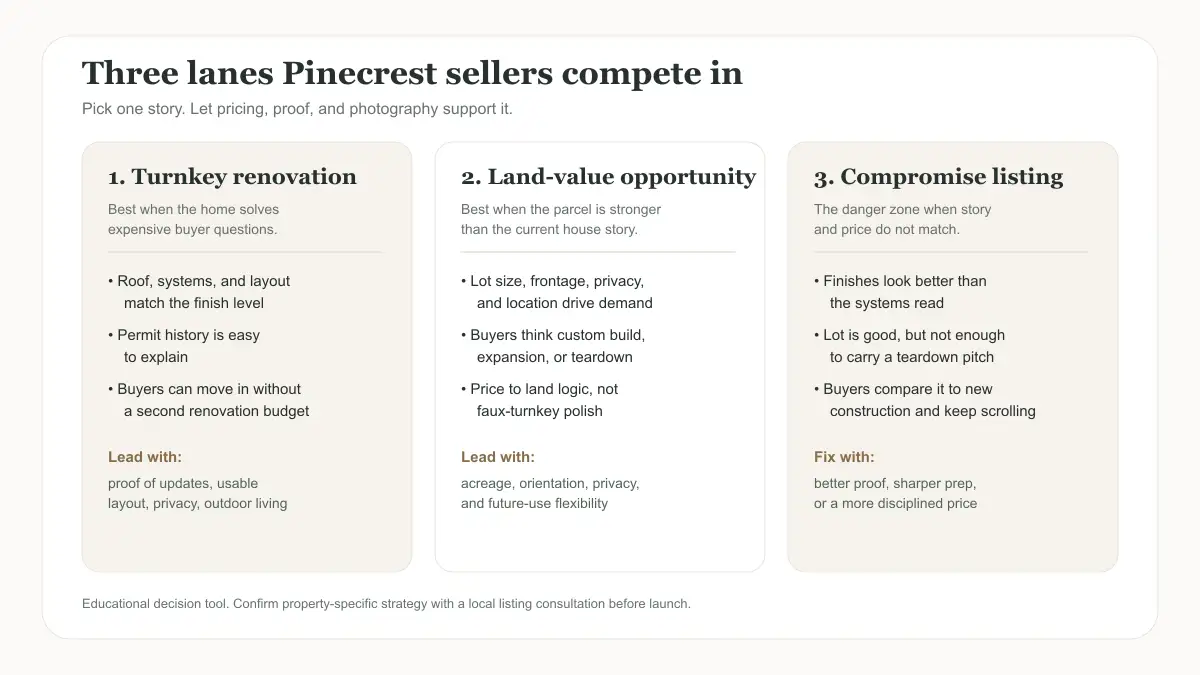
If I were preparing a Pinecrest seller for launch, I would sort the home into one of three lanes before talking about list price.
Lane 1: Turnkey renovation. This is where an older estate can genuinely compete with new construction. Joanna's Pinecrest guidance says homes built in 2000 or newer, or older homes that have been fully updated, tend to attract the strongest interest. "Fully updated" should mean more than a pretty kitchen. It should mean roofs, openings, plumbing, electrical, drainage, layout, and the outdoor experience all support the same premium story.
Lane 2: Land-value opportunity. Some Pinecrest buyers are still shopping for acreage, privacy, and rebuild potential. Joanna's Q2 update notes ongoing interest in new construction, teardown demand, and acreage opportunities in the $3M-plus range. If the home itself is no longer the lead asset, the lot, frontage, privacy, orientation, and future-use logic need to do the heavy lifting.
Lane 3: Compromise listing. This is the danger zone. The home is not truly turnkey, but it is also not clearly positioned as land. Maybe the updates are partial. Maybe the finishes photograph better than the systems read. Maybe the lot is good, but not enough to justify a rebuild narrative. This is where sellers most often need to reset either the scope of prep or the expectations around price.
A practical test helps: if a serious buyer spends ten minutes comparing your home to a new build, what argument survives the comparison? If the answer is only "but this is Pinecrest," the positioning work is not done yet.
What renovated sellers need to document before launch
A renovated Pinecrest estate competes best when the seller can prove that the expensive, unglamorous work is as real as the styling. Joanna's Pinecrest buyer guidance says buyers scrutinize roofs, plumbing, electrical, impact windows, exterior condition, landscaping, outdoor living, and lot functionality. That means your proof stack matters almost as much as your finishes.
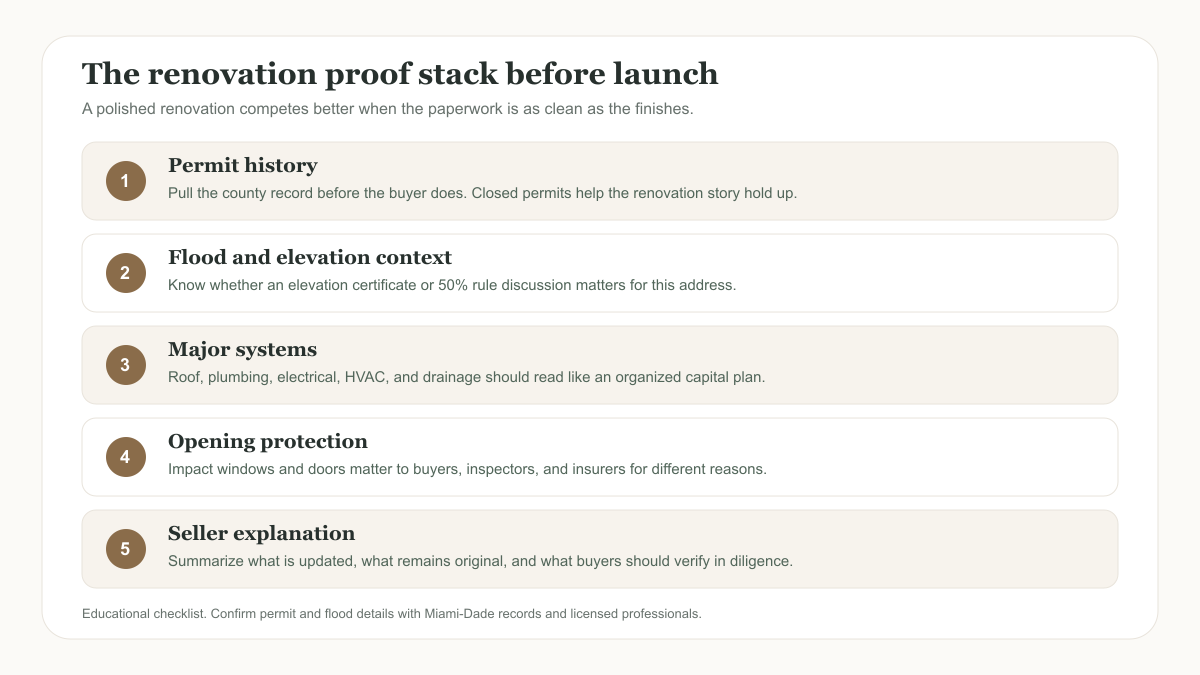 The renovation story gets stronger when the seller can show permit history, flood-elevation context when relevant, and a clean record of major systems and opening-protection work.
The easiest starting point is Miami-Dade's public permit and plans search. The county says building permits and plans, certificates of occupancy and use, code-compliance records, product approvals, and zoning records can all be searched online for free. For sellers, that turns vague memory into a clearer launch file: what was permitted, what was closed, what is still open, and what needs explanation before inspection questions start.
The second piece is flood and elevation context. Miami-Dade's elevation certificate guidance says Elevation Certificates are required for all new construction and substantial improvements in the county's flood-review framework. The county also warns that when a house in a flood zone is below the required elevation, the so-called 50% rule can apply if damage and/or improvements exceed 50% of market value. That does not mean every renovation triggers a raise-the-house conversation. It does mean sellers should not talk casually about a "complete redo" without understanding how permitting and flood-elevation rules fit their property.
For a renovated seller, the strongest pre-launch packet usually includes:
- permit history for major work
- dates and scope for roof, windows, doors, electrical, plumbing, and HVAC updates
- any elevation-certificate or flood-zone documents that matter to the address
- receipts, warranties, and contractor names when available
- a plain-language explanation of what was improved, what remains original, and what a buyer should verify during diligence
This is where Joanna's existing Pinecrest home upgrades guide becomes useful as a companion read. Upgrades help value only when buyers believe the work was done well, documented well, and priced honestly.
When lot value should lead the pricing story
Not every older Pinecrest estate should try to beat new construction on polish. Sometimes the better seller strategy is to stop competing on finish and start competing on what new construction buyers need in the first place: land, privacy, location, and possibility.
Joanna's Q2 Pinecrest update says demand remains focused on land, space, established-neighborhood value, and redevelopment opportunities. That matters because the buyer who wants to build, expand, or reimagine a property is solving a different problem than the buyer who wants to move in next month.
If the lot is the real asset, let the pricing story reflect that. Show the setback feel. Show how the outdoor space lives. Show what makes the parcel rare in its immediate pocket. Show why the address and lot utility matter even if the house itself is not the hero. A seller who forces a tired improvement story onto a land-driven asset often loses both audiences: the renovation buyer is unconvinced, and the land buyer thinks the seller is denying reality.
The opposite mistake also happens. Some sellers understate a genuinely useful renovation because they assume every buyer only cares about a teardown. That can leave money on the table when the house already solves enough expensive problems to make "move in and refine later" more attractive than starting from zero.
The point is not to label every older estate the same way. The point is to decide which value driver is actually carrying the property, then let the launch language, photography, and price support that story.
How to compete without copying a new-build price
The most expensive mistake in this lane is pricing an older estate as if the market will award it new-construction certainty. Joanna's Pinecrest seller guide says buyers disengage when a listing feels overpriced relative to condition, lot size, or updates. In a selective market, that is usually what happens before a seller ever gets the chance to "explain" the home.
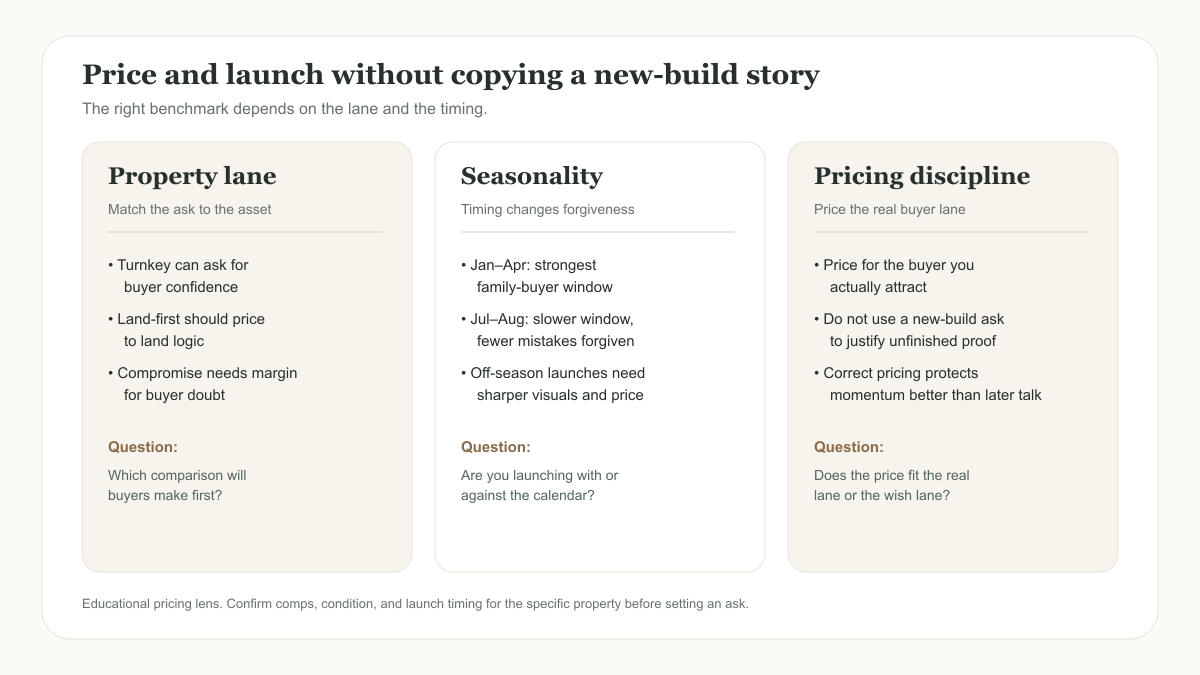 Pricing works best when it matches the property's lane and the launch window. A summer launch with a partial-renovation story needs more discipline than a spring launch with a true turnkey package.
A better approach is to price against the right benchmark:
- Turnkey renovation: compete against the best older-home alternatives and discount only where the buyer still inherits uncertainty.
- Land-first property: compete against other rebuild or acreage opportunities, not against glossy new builds that solve a different buyer problem.
- Compromise listing: assume the market will notice the gap quickly and price for that truth from day one.
Timing sharpens this. Joanna's 33156 timing guide says January through April is the strongest season and July through August is the slowest, with summer showings down roughly 30% to 40% compared with peak season. That does not mean you cannot sell in summer. It means the story and the price have to do more work. A seller launching in a slower window with a partial-renovation narrative has less room for aspirational pricing because fewer buyers are available to overlook the friction.
If I had to simplify Pinecrest pricing discipline into one sentence, it would be this: price for the buyer you actually attract, not the buyer you wish would rationalize the gap.
A seller checklist before photos and showings
Before a Pinecrest listing goes live against fresh construction, I would want these questions answered clearly:
- Which lane are we in? Turnkey renovation, land-first opportunity, or compromise listing?
- What is fully updated versus cosmetically improved? Buyers notice the difference quickly.
- What can we prove on permits and major systems? Pull the record before the buyer does.
- Does flood or elevation context need explanation? If yes, prepare the documents and the language now.
- What is the hero asset? Lot size, privacy, layout, finishes, school-area convenience, or move-in ease?
- Does the price match the lane? Not the dream lane, the real one.
- Does the launch window help or hurt us? Summer requires more discipline and better visuals.
If you can answer those questions with confidence, an older Pinecrest estate can compete very well. If you cannot, the home may still sell, but the market will decide the story for you.
For a property-specific strategy, I would start with Joanna's seller consultation page and then compare the home against the actual buyer lane it belongs to. In Pinecrest, the strongest outcomes usually come from honesty first and polish second.
This article is educational real-estate commentary, not legal, tax, appraisal, insurance, or construction advice. Permit records, flood-zone requirements, and market conditions can change; confirm details with Miami-Dade and your licensed professionals before making a listing decision.
Selling in ?
Get a free valuation or explore seller services in your area.