Pinecrest Gardens Weekend Showing Strategy for Nearby Sellers
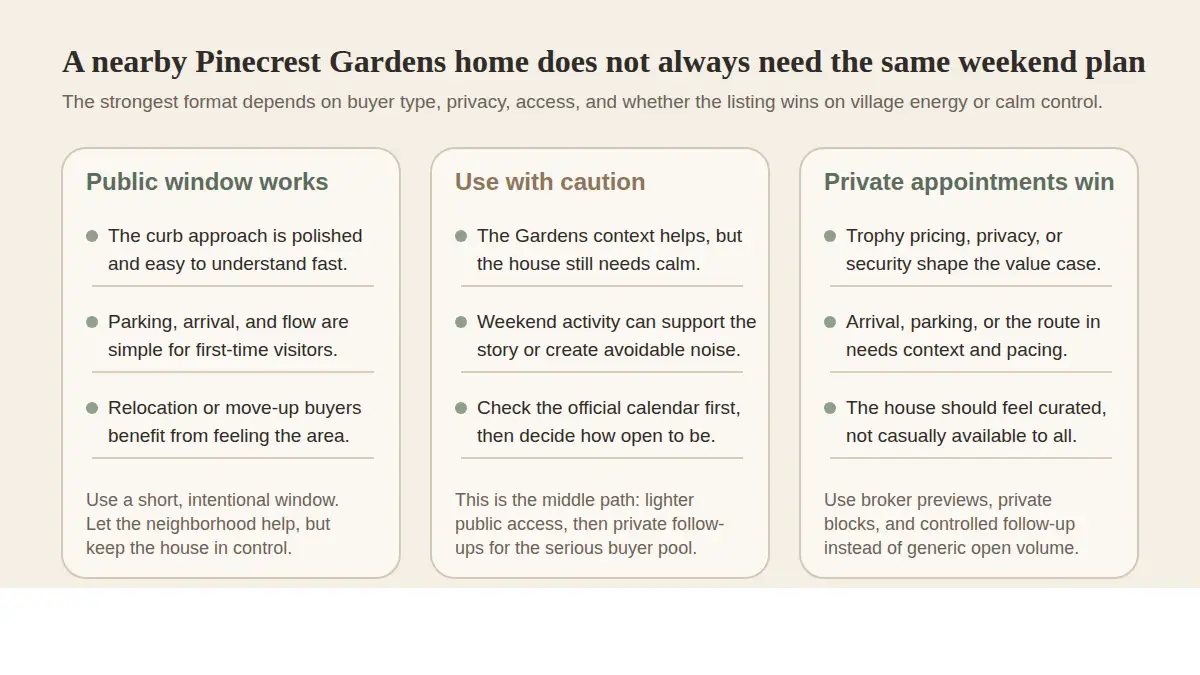
A smart Pinecrest Gardens weekend showing strategy is not the same thing as saying yes to every Sunday open house. When I prepare a listing near the Gardens, I start with a more useful question: what kind of buyer story does this home actually support? Some nearby properties benefit from weekend village energy. Buyers can feel the North Pinecrest setting, picture the canopy, and connect the home to one of the most recognizable landmarks in 33156. Other properties lose leverage if the showing plan feels too public, too noisy, or too casual for the price point.
That distinction matters because Pinecrest Gardens is not a random amenity pin on a map. The Village describes it as a 14-acre botanical garden that welcomes more than 140,000 visitors each year and serves as a venue for arts, education, and environmental programming. In other words, it shapes how outsiders experience Pinecrest before they ever understand the micro-neighborhood. A seller near the Gardens should use that thoughtfully, not lazily.
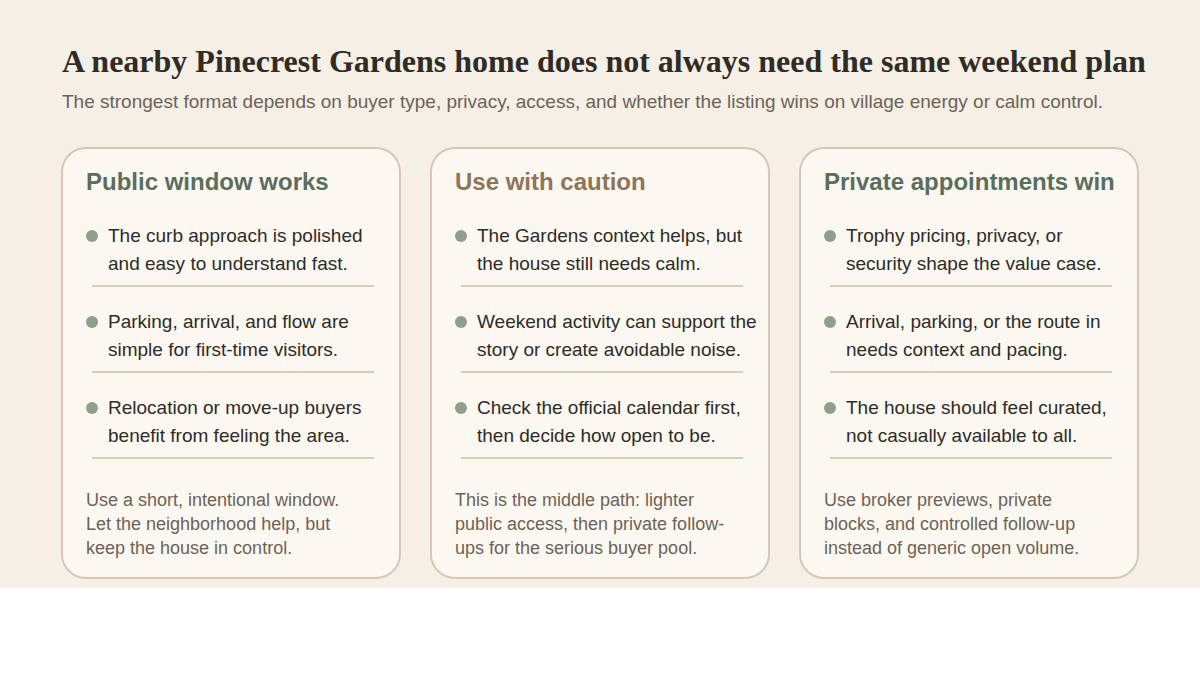 Near the Gardens, the best showing plan depends on buyer type, privacy level, access, and how convincingly the home supports a North Pinecrest story.
Why Pinecrest Gardens changes buyer perception
In North Pinecrest, landmark value is rarely just about distance. It is about identity.
On Joanna's North Pinecrest page, I explain that micro-pockets near Gulliver and Pinecrest Gardens trade differently because buyers are not comparing those streets to generic 33156 inventory. They are comparing a very specific version of Pinecrest: estate lots, mature canopy, village-heart character, and a setting that feels established before anyone talks about finishes. That is why the same page says buyers pay premiums for Pinecrest Gardens adjacency, lot size, privacy, and legacy character instead of only reacting to a ZIP code label.
This is also why a showing plan can either reinforce the price or quietly undermine it.
If the home sits genuinely close to the Gardens and the approach feels elegant, calm, and on-brand, nearby weekend activity can make the location easier to understand. Buyers who are new to the village can see the neighborhood context in real time. They can connect the house to a place they already recognize from Pinecrest's community identity. And when the property is properly prepared, that backdrop makes the listing feel more specific than another luxury home with a vague "great Pinecrest location" line.
But proximity is not a blank check. I do not treat Pinecrest Gardens the way a lower-context market might treat a coffee shop district or retail corridor. A luxury buyer in North Pinecrest is still evaluating privacy, ease of arrival, traffic feel, lot quality, and whether the house itself supports the story being told. Pinecrest Gardens helps frame the narrative. It does not replace the narrative.
That is why I like to think of the Gardens as a buyer filter, not a guaranteed premium. The right buyer will read the setting as civic quality, culture, and village identity. The wrong showing plan can make the same setting feel crowded, imprecise, or overhyped.
When weekend event energy helps a showing window
There are times when I absolutely want a listing near the Gardens to benefit from weekend momentum.
The Village's general calendar tells visitors to use the Parks and Recreation or Pinecrest Gardens departmental calendars for the full list of events, programs, and classes. The official Parks Calendar also links directly to the Pinecrest Gardens calendar, which is useful because it gives sellers a concrete reminder: before we talk about an open window, we should first understand what the area is actually doing that weekend.
For example, the Village's composting program page says Sundays are a special day for composting at the Pinecrest Farmers Market next to the entrance of Pinecrest Gardens. A Village news post adds that residents can enjoy the farmers market just outside the Gardens on Sundays. That does not mean every nearby home should schedule a Sunday open house. It does mean the location has a real weekend civic rhythm, and in the right situation that rhythm can help a buyer feel the neighborhood instead of only hearing it described.
Weekend energy usually helps when three things are true:
-
The listing benefits from emotional neighborhood context.
This is especially true for homes whose value case includes village feel, established canopy, family routine, or recognizable North Pinecrest identity. -
The home is ready for quick, clean first impressions.
Nearby activity helps only if the property itself feels polished from the curb to the foyer. If the landscaping, parking instructions, or entry sequence are loose, the location energy becomes distraction instead of reinforcement. -
The likely buyer is still building a mental map of Pinecrest.
Buyers relocating from outside the village often respond well when the setting helps them understand why this block feels different from a broader Miami search result.
Here is the quick version I use:
| Listing situation | Better weekend plan | Why |
|---|---|---|
| Move-up family or relocation buyer, polished home, easy parking | A controlled public showing window | The area context helps the buyer feel the village story quickly. |
| Mid-range luxury listing that wins on livability and location | Limited weekend access plus private follow-ups | You get neighborhood energy without overexposing the house. |
| Trophy, privacy-sensitive, or security-conscious property | Appointment-led strategy | The price point usually needs discretion more than foot traffic. |
When weekend activity does help, I still keep the plan disciplined. I prefer a defined window, clear arrival instructions, a clean staging sequence, and messaging that ties the home to the neighborhood without sounding theatrical. The home should feel composed, not opportunistic.
When privacy, traffic, or trophy positioning call for appointments instead
One of the most useful lines on Joanna's North Pinecrest seller page is the reminder that North Pinecrest luxury marketing should include discreet outreach rather than rely only on weekend open-house volume. That is a small line, but it captures the real issue perfectly.
Some homes near Pinecrest Gardens should not be treated like broad-audience Sunday inventory.
If the property is asking luxury buyers to pay for privacy, scale, custom architecture, security, or an especially refined lot experience, I usually want more control over how the showing unfolds. The more expensive and more nuanced the listing becomes, the less I want casual traffic determining the first impression. Appointment-led tours let me manage the route in, the pace of the viewing, the explanation of features, and the quality of follow-up.
That is especially important when:
- the home has a long or unusual arrival sequence;
- guest parking is limited or easy to confuse;
- the property backs up to noise, service access, or another feature that needs context;
- the seller is privacy-sensitive;
- the house is priced in a band where buyers expect a curated experience, not just availability.
This is where many sellers get tripped up. They assume that being near a high-profile landmark means more visibility is always better. In reality, the correct showing plan depends on what the home is trying to defend.
If I am defending exclusivity, I do not want the weekend plan to feel casual.
If I am defending a quiet, estate-like setting, I do not want the arrival experience to feel chaotic.
If I am defending a premium ask, I need the showing format to support a premium emotional response.
That does not mean "never open." It means use openness selectively. Broker previews, invitation-only blocks, and tightly managed private tours can outperform a generic public schedule when the home's strongest value is composure rather than convenience.
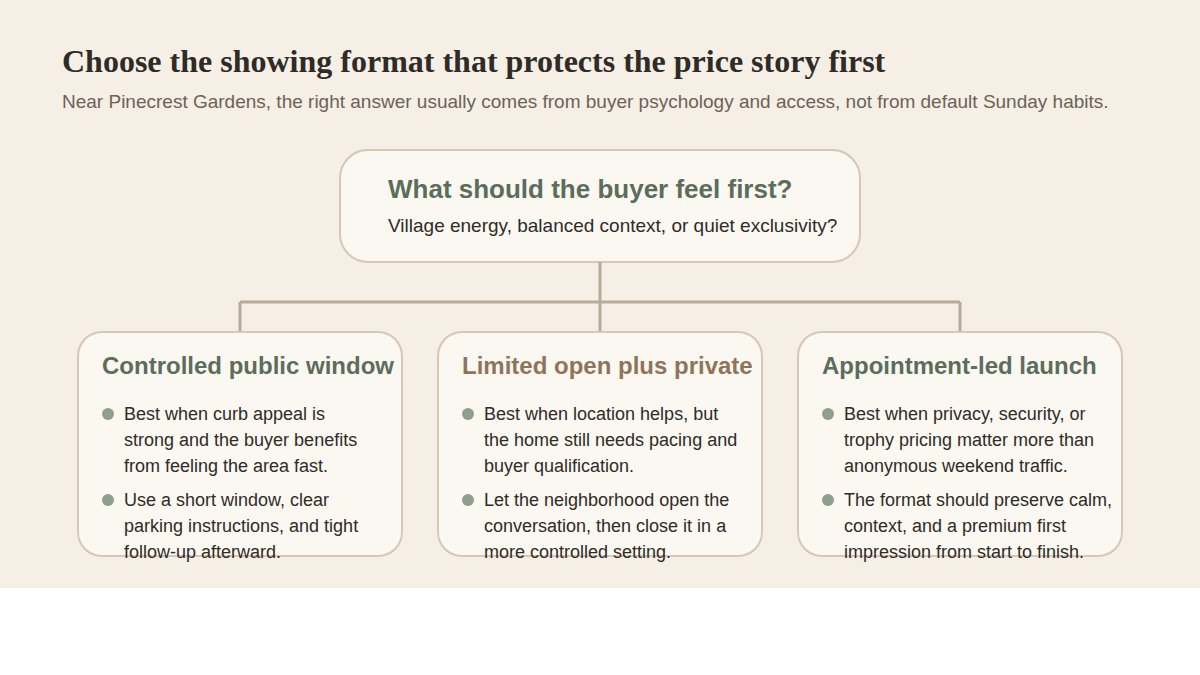 The better showing format is the one that protects the home's actual value story, not the one that creates the most anonymous traffic.
How to prove true proximity without vague prestige language
The cleanest Pinecrest Gardens marketing is specific.
On the North Pinecrest seller page, I tell sellers to measure and market distance to Gulliver and Pinecrest Gardens rather than rely on generic claims. I still believe that is the right standard. If the home is truly close, prove it. If it is only loosely nearby, say less.
Good proximity language might mean:
- naming the exact relationship to the Gardens entrance or SW 111th Street area;
- describing the route in plain English;
- using accurate travel framing only when it is genuinely defensible;
- tying the landmark to the buyer experience, not just to prestige.
Weak proximity language usually sounds like this:
- "minutes from everything"
- "walkable to Pinecrest Gardens" when that has not been checked carefully
- "village heart" for a home that is technically in the ZIP but not functionally experienced that way
- school or amenity language borrowed from a stronger street nearby
The more expensive the listing, the more dangerous fuzzy language becomes. Luxury buyers are fast to detect copied neighborhood copy. If the distance, arrival feel, and amenity connection are real, the property does not need exaggerated phrasing. If those points are not real, exaggeration only makes the pricing feel less believable.
This is also where calendar awareness helps. The official village and Gardens calendars are not just visitor tools. They help sellers think like operators. Are you launching on a weekend when the Gardens will reinforce the story, or on a weekend when the area will feel busier than the buyer should first experience it? Are you depending on the Sunday market as neighborhood proof, or would that same activity complicate parking and shorten the kind of private attention the property needs?
Those are strategy questions, not decoration. When I market a home near Pinecrest Gardens well, the proximity claim, the showing format, the price band, and the buyer target all sound like they came from the same brain.
The showing mistakes that weaken nearby listings
Most nearby listings do not underperform because Pinecrest Gardens is unhelpful. They underperform because the seller uses the landmark too loosely.
The most common mistakes are:
-
Treating every Sunday as a good open-house Sunday.
A seller should check the official calendars first, then decide whether the local rhythm helps the property or creates friction. -
Using the Gardens to justify the price without proving the home's own value.
Landmark adjacency can support a story. It cannot rescue deferred maintenance, awkward flow, or a loose comp set. -
Confusing visibility with buyer quality.
For some homes, more visitors are not better visitors. -
Overclaiming walkability, schools, or "village heart" status.
If the statement would not survive a buyer's first drive or map check, it should not be in the marketing. -
Letting the event setting overpower the home's tone.
A serious estate should still feel calm and deliberate, even when the neighborhood has weekend activity around it.
The practical test I use is simple:
| Ask before launch | Why it matters |
|---|---|
| What exact buyer am I trying to attract first? | The showing format should match the likely decision-maker, not the maximum possible crowd. |
| What can I prove about proximity? | Precision builds trust and supports the ask. |
| What weekend conditions will the buyer actually experience? | Real parking, flow, and neighborhood feel matter more than pretty map pins. |
| What part of the price story comes from the house itself? | The landmark can strengthen the case, but it cannot be the whole case. |
If those answers are muddy, the showing plan is probably muddy too.
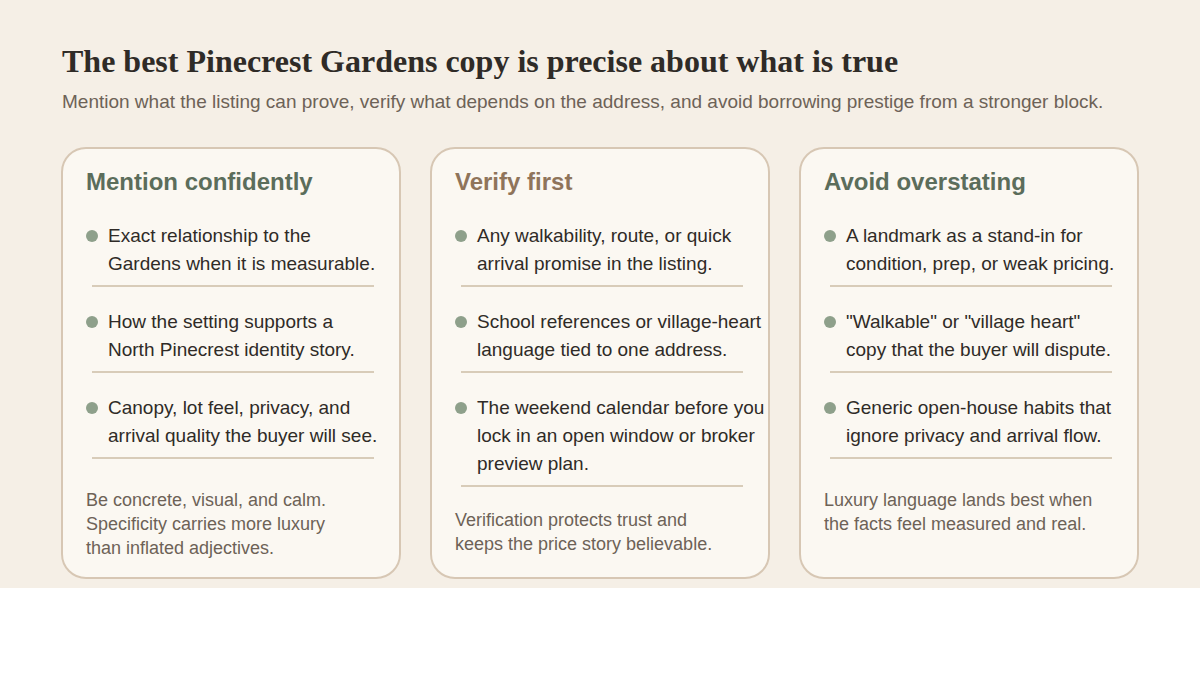 The strongest nearby listings are precise: they say what the seller can prove, verify what matters by address, and avoid borrowing prestige from a stronger block.
How to brief Joanna before launch
Before I would put a nearby Pinecrest Gardens home on the market, I would want six questions answered clearly:
-
Who is the first buyer I want to attract?
Relocation family, move-up household, private luxury buyer, or some combination? -
What does this home gain from being shown publicly?
Neighborhood context, urgency, and ease of discovery - or just extra foot traffic? -
What does this home lose if the showing feels too open?
Privacy, calm, pacing, perceived exclusivity, or seller comfort? -
What can I state precisely about Pinecrest Gardens proximity?
Distance, route, visibility, convenience, and calendar context should all be accurate. -
Which weekend supports the house best?
Not the first available one - the one that reinforces the listing story. -
What prep work makes the location story easier to believe?
Landscaping, parking flow, front-entry clarity, lighting, staging, and photography all matter more when the house is selling a refined North Pinecrest experience.
That is the conversation I would rather have than debating whether every seller near the Gardens "should do an open house." Some should. Some absolutely should not. The win comes from matching the format to the buyer psychology, the price point, and the exact street-level experience the home can honestly deliver.
If you are preparing to sell near Pinecrest Gardens, start with a strategy session instead of a default showing template. You can review North Pinecrest positioning through Joanna's North Pinecrest seller page or request a broader Pinecrest home valuation to pressure-test pricing, launch timing, and showing format before the listing goes live.
This article is educational and is not legal, appraisal, tax, or school-assignment advice. Showing results, buyer response, and location premiums vary by address, condition, inventory, and timing, so confirm the right launch strategy for your property before relying on this guidance.
Selling in ?
Get a free valuation or explore seller services in your area.