Back-to-School Listing Window in 33156: How Pinecrest Sellers Time August and Fall
A smart back-to-school listing window in 33156 is not really about squeezing a sign into the yard before classes start. It is about deciding whether your home can go live with a clean strategy before family schedules harden around August 13, or whether you are better served by finishing prep and relaunching after the first school-week scramble. In Pinecrest, that distinction matters because Joanna's best time to sell in Pinecrest guide already frames July and August as the slowest stretch of the year, while her Pinecrest seller page is built around consultation, pricing, preparation, and premium launch sequencing rather than improvisation.
The official Miami-Dade County Public Schools calendars page and the district's 2026-2027 elementary and secondary calendar PDF give that late-summer choice a real deadline. The 2026-2027 school year begins on August 13, 2026. That does not make every August listing a mistake. It does mean that many family buyers stop behaving like flexible movers and start behaving like households protecting routines, commute patterns, and the first weeks of the new school year.
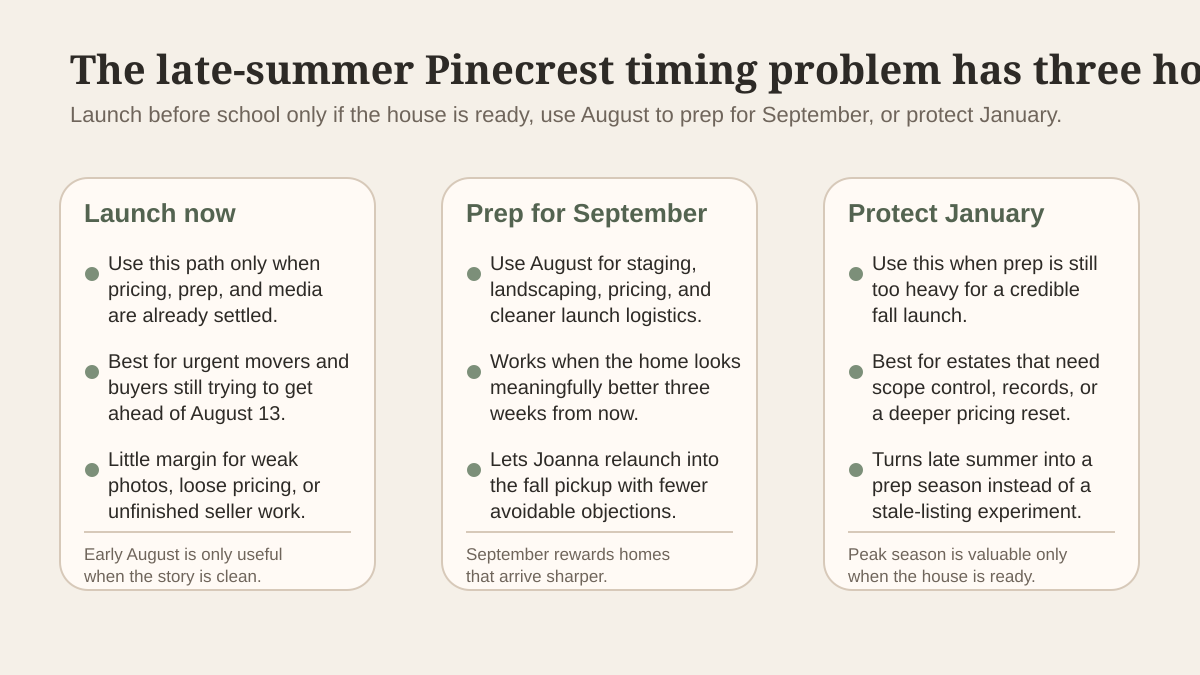 Once August arrives, the best answer is usually launch now, prep for September, or hold for January — not "maybe."
Why the back-to-school window feels tighter in 33156
Pinecrest is not a generic South Florida market. Joanna's own timing guidance says the strongest family-buyer window still runs from January through April, because that is when households can shop, negotiate, and close in time for a summer move. Her timing piece also says July and August are usually the softest part of the calendar, while September through early November behaves like a smaller second season.
That pattern matters more in 33156 than it does in a neighborhood where buyers are driven mostly by architecture or nightlife. Joanna's existing school-value guide makes the local point clearly: education-driven households often organize the move around the next school year, not just around interest rates or weather. Even when a buyer is not changing schools, the rhythm of carpools, activities, tutoring, and after-school life shapes how available they are for tours and how eager they are to absorb disruption.
For sellers, the practical consequence is simple. By early August, a family buyer may still love the house, but they are no longer evaluating it in the same emotional frame they had in March. They are asking harder questions about move timing, possession dates, first-week routines, and whether the household can take on a closing and a move while trying to get children settled. That does not eliminate demand. It narrows the kind of demand you are trying to convert.
This is why the late-summer question should never be, "Is anyone buying?" The better question is, which buyer pool is still easy to activate, and is my home ready for that buyer pool right now? If the answer is relocating executive family with a firm deadline, the launch plan may still work. If the answer is broad family demand with no obvious urgency, a rushed August debut can waste attention you would rather preserve for September or January.
What the 2026-2027 school calendar changes for sellers
The district calendar creates more than one useful signal. The biggest one is obvious: August 13 is the first day of school. If you are trying to attract buyers who want a calm move before classes begin, the home usually needs to be fully ready well before that point. Photos, pricing, staging, disclosures, and showing instructions cannot still be wobbling.
The subtler calendar cues are just as useful. The district's 2026-2027 PDF also shows teacher-planning days without students on September 21, December 18, January 15, March 10, and March 29, and it notes that elementary and K-8 students are released one hour early every Wednesday. Those details matter because they change when parents are free, when traffic patterns feel chaotic, and when showings will interrupt a normal family afternoon.
For a Pinecrest seller, that means timing is no longer only about the month. It is also about the week shape inside the month:
- the first week of school is often noisy and operationally messy;
- Wednesday afternoons can be less convenient for family-focused tours because of early release schedules;
- and certain no-student days create cleaner windows for travel, consultations, or long-viewing appointments.
Used correctly, the calendar helps you reduce friction. Used lazily, it can make a listing feel as though it arrived at the exact moment every likely buyer had something else to manage.
The three workable listing windows once August arrives
By the time August shows up, most Pinecrest sellers have three credible choices.
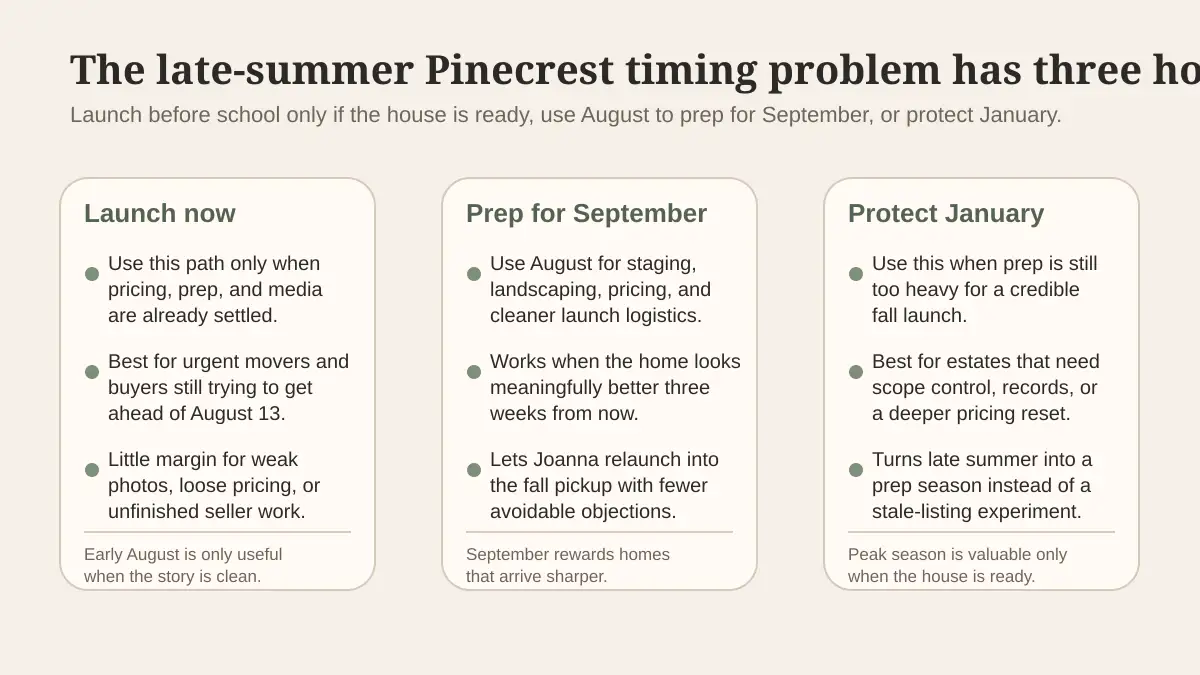
1. Launch before school starts
This path works only when the home is already truly ready. Not almost ready. Ready. The price story is settled. The photography is strong. The repairs that matter are done. The showing instructions make sense. If you still need a contractor, a staging decision, or a serious pricing reset, you are probably not in this lane.
The advantage is that you still catch buyers who are moving with urgency and have not fully shifted into school-year protection mode. The drawback is that there is very little room for a soft or confused first impression. If the home hits the market with mixed signals in early August, you do not get the best of both worlds. You get summer softness plus school-start distraction.
2. Use August for prep and relaunch in late August or September
For many 33156 sellers, this is the most disciplined answer. Joanna's timing guide already treats September as a real secondary season. If August is better used for staging, media, landscaping, disclosure cleanup, and pricing discipline, then a late-August or early-September launch can feel sharper than a hurried pre-school debut.
This is especially true when the home needs explanation. A renovated-but-not-brand-new house, a property with unusual grounds, or an estate with privacy logistics often benefits from a cleaner narrative more than from one extra week on market. The seller loses very little by taking August seriously as a prep month if that creates a better September first impression.
3. Hold for January if the reset is bigger than a few weeks
Sometimes the honest answer is that fall is still too soon. If the property needs more extensive work, if the seller is still sorting trust or family decision-making, or if the strategy will live or die on the larger family-buyer pool Joanna sees in January through April, then waiting can be the adult answer.
That is not market paralysis. It is calendar discipline. A seller who uses August through December to settle scope, improve presentation, verify records, and prepare premium media can enter January with much more leverage than a seller who tests the market in a half-ready state and then spends the holidays carrying stale days on market.
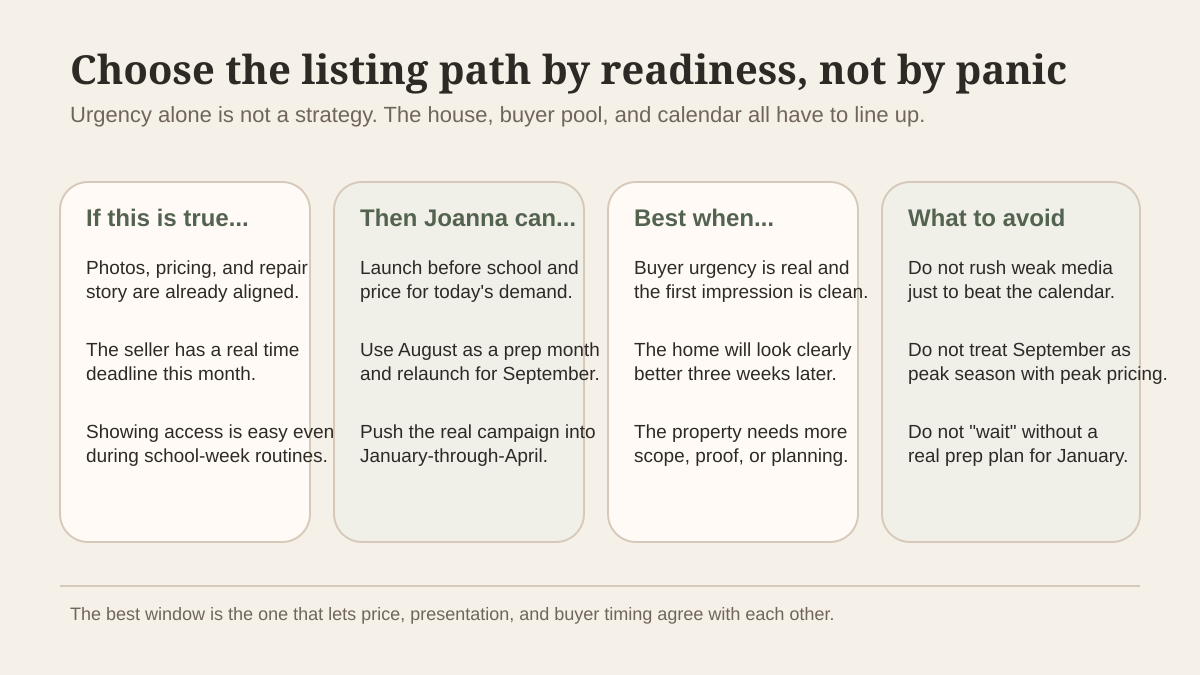 The right window depends less on optimism than on how ready the house and household actually are.
When late August or September beats a rushed pre-school launch
Sellers often hear "back-to-school" and assume the opportunity is gone the minute classes start. That is too simplistic. In Pinecrest, September can still work well when three things are true.
First, the home looks clearly better in September than it would have looked on August 8. That might mean stronger landscaping after cleanup, better photography after decluttering, tighter pricing after Joanna's micro-neighborhood review, or clearer documentation around updates and permits.
Second, the buyer story is sharper. A late-August or September launch can work very well when the property appeals to serious buyers who are not only chasing a last-minute summer move. Think households relocating on a corporate schedule, families who missed spring but still want to buy before year-end, or buyers who respond to a polished estate narrative more than to pure calendar urgency.
Third, the seller is not pretending September is spring. Joanna's timing guide treats fall as a second-best window, not a duplicate of peak season. That means the launch still has to be crisp, and the price still has to respect current competition. September is useful because attention comes back. It is not useful if the home is priced like peak March with no justification.
This is where Pinecrest sellers sometimes make the wrong compromise. They rush an August listing to avoid "missing the school season," then discover they would have been better off spending three more weeks fixing the things buyers notice immediately. When the home is a little off, September usually rewards the seller who arrives cleaner more than the seller who arrived earlier.
How to run showings when family logistics get louder
Once the school year begins, showing strategy becomes a quality-of-life issue for the buyer and the seller. The district calendar gives you clues about where friction will show up, and Joanna's seller process gives you the structure for responding to it.
Start with the obvious: mornings and late afternoons become more protected. Carpools, drop-off routes, activities, and homework rhythms make spontaneous access harder for many family households. If your likely buyer is education-focused, a poorly timed weekday showing request can feel intrusive even when the house is otherwise compelling.
That is why sellers should think beyond "available or unavailable." Better questions are:
- Which weekdays feel easiest for after-work tours?
- Should Wednesday afternoons be treated carefully because of early-release routines?
- Are there school-activity bottlenecks that make certain evenings poor choices?
- Does the property need a more structured Saturday cadence once family schedules tighten?
The same logic applies on the seller side. Households already living in the home may also be managing school routines, pet schedules, house staff, or gate access. Joanna's seller page emphasizes full-service coordination because a strong launch is not just marketing. It is operational clarity. If sellers are still making showing decisions ad hoc in the first school week, the friction shows up in delayed approvals, poor access, and choppy buyer experiences.
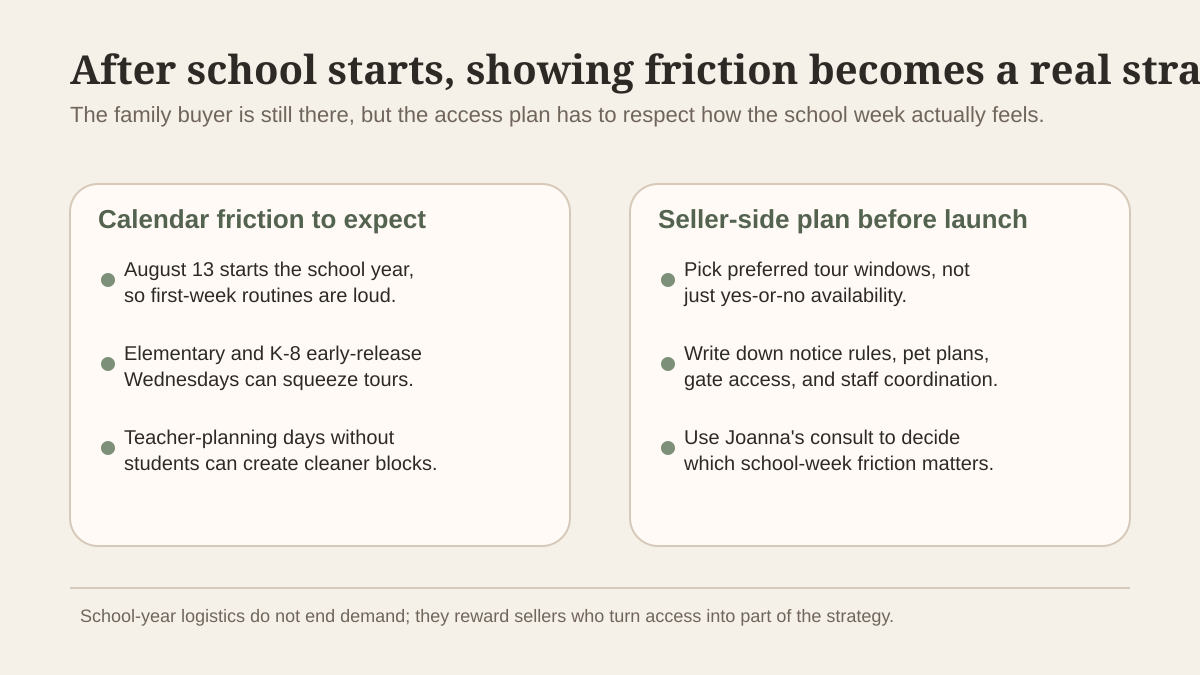 School-year logistics do not kill demand, but they do punish sellers who have no access plan.
The practical answer is to write the plan down before launch. Decide the preferred tour blocks. Decide what notice is required. Decide whether a Wednesday should be lighter than a Thursday. Decide how gate or staff coordination works. Buyers do not need every internal household detail; they do need a showing experience that feels deliberate rather than improvised.
What Joanna should answer before you choose a launch week
A consultation for this article's timing problem should not end with a generic "now is fine" or "wait until spring." It should answer more specific questions:
- What buyer profile is most realistic for this home if it launches in the next 30 days?
- Does the property need the broad family-buyer pool of peak season, or can it sell well to a narrower but serious fall audience?
- What prep item would hurt the launch most if we rushed it?
- Would three more weeks materially improve pricing power, photography, or showing experience?
- If we wait for September, what exact work gets done in August?
- If we wait for January, what proof should be ready by then so peak season is not wasted on prep?
Those questions matter because timing is not a superstition. It is part of pricing strategy. Joanna's Pinecrest process already moves from consultation to pricing, preparation, launch, and transaction management. The launch week should be the outcome of that sequence, not the first decision made in isolation.
When waiting for January is smarter than forcing fall
Sellers usually resist this answer because January feels far away. But in Pinecrest, January through April remains the cleanest family-buyer season in Joanna's own guidance for a reason. It lines up with relocation planning, school-year decisions, and the largest concentration of serious family demand.
If the home needs heavier landscaping, bigger improvement work, more careful estate positioning, or a deeper records cleanup, forcing it into late summer or fall can be false efficiency. A stale fall listing that gets cut and carried into winter is often more expensive than a deliberate plan that enters January with clarity.
The key is not to "wait" passively. If January is the right target, then August through December should produce something tangible: updated media, verified records, disciplined scope, refined pricing logic, and a sharper understanding of whether the home should compete on turnkey polish, land value, privacy, or school-driven convenience. That is the work that makes peak season valuable.
For Pinecrest sellers, the best late-summer move is often the one that protects the next strong window instead of burning it early. If you are choosing between an August launch, a September relaunch, or a January plan, the right answer usually comes down to readiness, buyer fit, and how much friction the school-year calendar adds for your likely audience.
If you want a property-specific answer, bring Joanna the timing problem before you bring her a launch date. Her process works best when the schedule follows the strategy, not the other way around. You can start that conversation through her seller services in 33156 or directly by phone at (305) 302-6384.
This article is educational and is not legal, tax, insurance, or valuation advice. School calendars, school assignments, showing logistics, and buyer behavior can change, so confirm details on the official district site and with the appropriate professionals before relying on them in a transaction.
Selling in ?
Get a free valuation or explore seller services in your area.